CIGS Lights Up, Crashes Servers
by Jonah white
This column originally ran in Back Alley Games Issue 19, September 2025
If there was one takeaway from CIGS this year, it was that there is a growing appetite for independent video games in the Midwest. Like a katamari rolling through the cosmos, CIGS continues to get bigger as it rolls along.
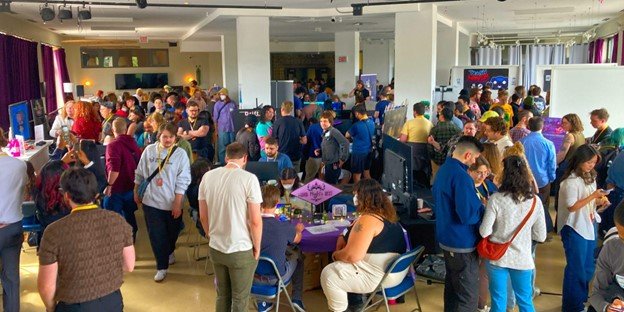
After filling the humble Vault Gallerie to bursting last year, Indie City Games decided to host this year’s showcase at the larger Hairpin Arts Center. Despite the extra floor space, the showfloor still struggled to contain the crowds of people that filed in and out of the exhibit across nine hours.
It was not just the crowds that were bigger. After a smashing Kickstarter campaign that saw all of its stretch goals met, ICG showed up loaded with swag. The merch table offered physical copies of Back Alley Games, a hardcover collection of the first 10 issues, postcards, raffle tickets, and a plethora of stickers, T-shirts, and other goodies.
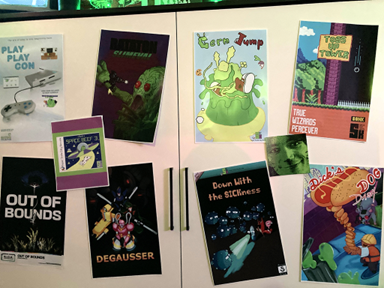
The number of games on display increased as well, from 24 last year to 39 this year. There were so many PCs running so many games over so many monitors that the building itself could barely handle it, and a breaker was tripped at least once during the day. Clearly, next year calls for a bigger and more powerful space to host the CIGS community.
More than just roguelikes
The video games on display covered a range of genres, including interactive fiction, visual novels, games with alternative controls, action games, dungeon crawlers, racing games, fighting games, fan games, and more. For every white-knuckle twitch-reflex action game, there was a slow, thoughtful, meditative game that asked to be explored and reflected upon.
The exhibitors reflected a similar diversity. Alongside the many solo developers, Chicago Public Library had a booth promoting their Gamers Universe event, a regular showcase featuring the work of teenage game developers.
Even analog games were represented in the form of Zinigames, a unique line of pocket-sized puzzles procedurally generated on the PC for replayable print-and-play gaming.
There were even presenters from beyond the boundaries of Chicago. Representatives from STLGameDev, the St. Louis-based dev community, came to show off some of their games, many of which they plan to install in an arcade cabinet in the future.
Hard talks for hard development
For the Very Important Gamers in the room, CIGS held a series of four seminars related to game design and running a successful game studio.
Jamie Danielle of Rookery Interactive was scheduled to give a fifth talk about forming a company, but the event was unfortunately canceled due to illness.
In the first seminar, game designer Bobby Lockhart shared a sneak peak of his upcoming book “The Game Designer’s Workbook,” featuring over 50 game design exercises that teach valuable skills for games both analog and digital.
Exercises will include narrative and level design challenges, breakdowns of design concepts, and cross-training exercises that bring in skills from other disciplines. All exercises can be done with pencil and paper, which Lockhart showed off by having participants create their own word search and sokoban block-pushing puzzles during the seminar.
Pre-orders for Bobby Lockhart’s book are available now at gamedesignersworkbook.com.
The second seminar featured Ryan Wiemeyer sharing some tips and tricks for using ink, the scripting language developed by inkle, the studio behind popular narrative games 80 Days (2014), Overboard! (2021), and Heaven’s Vault (2019).
After running through ink’s basic syntax, recommending a few plugins, and showing off a few types of dialogue trees, Wiemeyer showed the crowd how the simple scripting language could be used to create complex dialogue trees inside of Unity and Unreal Engine.
Using his upcoming game Max Gentleman Mystery Mansion as an example, he demonstrated how ink improved his workflow and allowed him to juggle many different variables during dialogue.
The third seminar was hosted by Kevin Zuhn of Young Horses, the makers of Octodad (2010) and Bugsnax (2020). He shared how Young Horses pitch games unlike anything else on the market in a talk titled: “Horsing Around: How To Pitch Games Like You’re On Drugs.”
Wild Horses’ three rules for creating game ideas are:
1) ride the shark fin,
2) pool rules, and
3) the ol’ fishbowl.
In brief, the “shark fin” refers to a graph that measures the quality of ideas over several rounds of pitching. The most original ideas tend to come out of round three, after the “obvious ideas” have been thrown out but before the ideas become incomprehensible due to designer burnout.
“Pool rules” refers to a list of “nos” (like a no diving, no running sign at a pool). These are ideas that Young Horses reject for being too popular and therefore unoriginal, like zombies, roguelikes, or deckbuilders.
Zuhn made it clear that none of these are bad ideas, only concepts that will not stand out in a saturated market.
The last rule, “the ol’ fishbowl,” refers to the act of throwing idea fragments into a fishbowl, drawing them out two at a time, and seeing if the combination makes a compelling game idea. By the end of this long and chaotic process, Young Horses are almost always left with an idea so weird and unique that publishers cannot possibly ignore it.
The fourth and final seminar was hosted by ace attorney Sam Castree, who shared a condensed but informative breakdown of 10 milestones at which a new indie game studio should involve a lawyer.
He began with the formation of a company, moved onto filing trademarks, and went on to cover contracts, securing funding, hiring playtesters, drafting a privacy policy and terms of service, securing copyrights, and hiring employees, before starting the whole process over again for the next game.
While full of good advice for running a business and avoiding legal problems, Castree’s most important piece of advice for studios was to lawyer up as soon as possible.
On that note, information on Sam Castree and his services can be found at castreelaw.com.
In just four talks, CIGS covered game design, efficiency tools, idea generation, and business law, highlighting just how complicated and multifaceted game design really is.
Beyond joysticks and jump buttons
More space meant more room for gaming-adjacent activities. A surprise addition this year was the flash tattoo station, where gamers could get a professional tattoo done in a matter of minutes simply by pointing at a design in a book.
There was also a crafting station full of paper and markers. Amongst the origami and scrap paper, there were also stacks of ICG-branded trading cards. Children and adults enthusiastically drew monsters on these cards and created rules for a game that does not exist.
Not only was the crafting station a nice distraction from the bustle and noise of the showfloor, but it also provided a nice space to exercise one’s own creativity. Perhaps in future years it can be expanded to become a miniature game design lab where participants can build prototypes and play with simple mechanics.
Even as the night wound down and the gaming PCs were stowed away, the party did not end, as a number of participants found their way to the nearby gaming lounge, Midlane Esports, for the afterparty.
Not content to knock back drinks and talk shop, Indie City Gamers set up a full-fledged tournament of one of the games showcased at CIGS: the PSX-skinned mecha-battler Drift Shell. The game was run on multiple PC stations and participants were paired off to battle it out in a one-on-one fight.
Despite being in development and giving little explanation about the controls and available loadouts, gamers were quick to pick up the controls and duke it out, reveling in the frantic low-fi action.
The Katamari ball keeps a’rollin
The Midwest gaming scene is growing. Over 500 gamers attended this year’s showcase, double last year’s attendance.
The success of their Kickstarter campaign means that ICG will be growing internally at the same time they’re growing the showcase, and with devs from all over the Midwest coming together to share their work, the network of gamers is growing too.
The future looks to be filled with more: more space, more networking opportunities, more collaboration, more artists and artisans from more industries, more seminars, and more games.
I am already excited to see what the next CIGS looks like and what the community will be able to produce in the coming year.