Detect-Dev interview: March 2024
by Seb Galvez
This article was originally published in Issue 1 of the ICG Zine, March 2024. It was reformatted in November 2025, but has not been edited further.
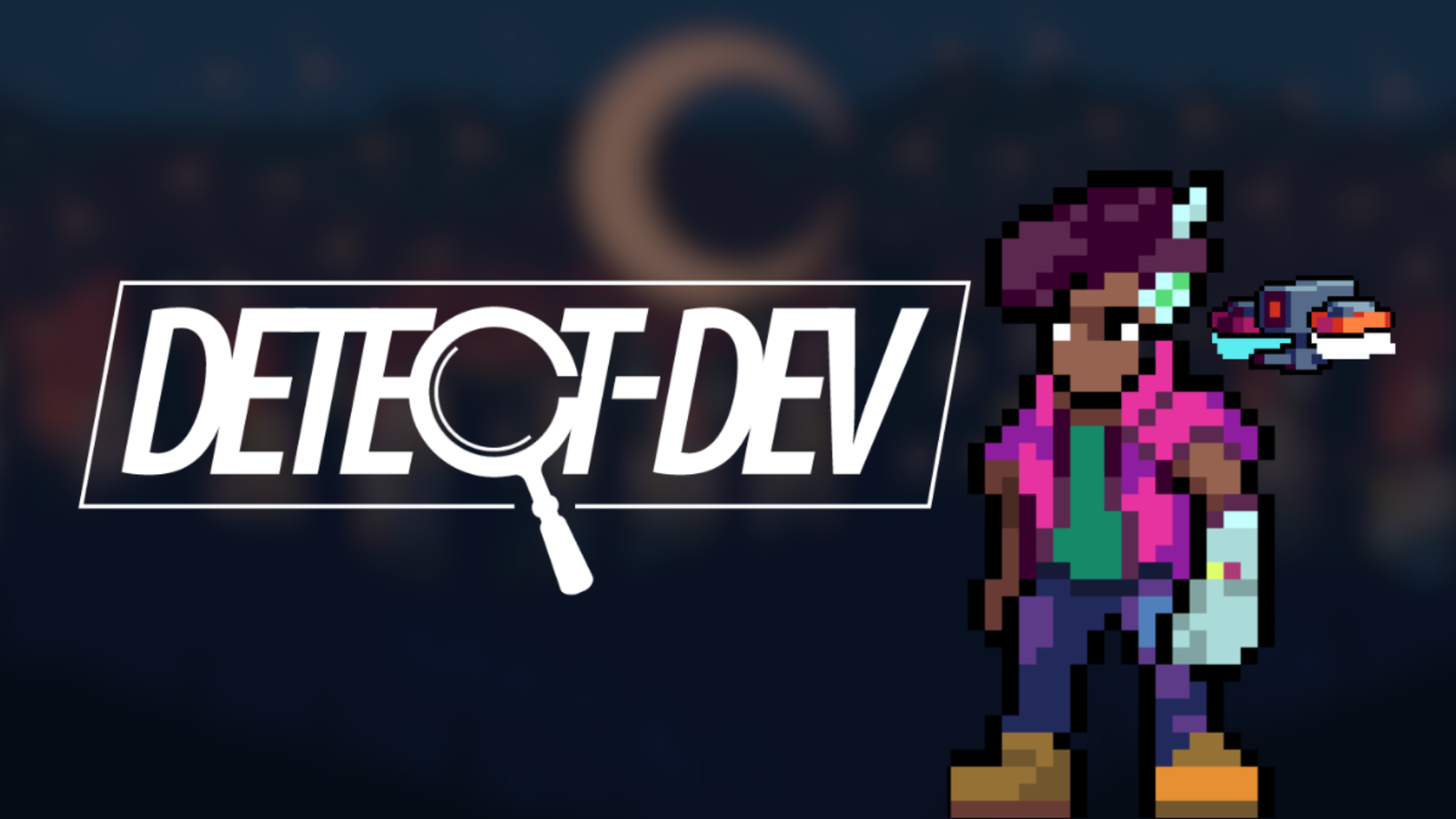
Detect-Dev bills itself as an alternative to the usual sleuthing fare in games, shifting its focus from hardboiled detectives to a near-future version of Chicago (“New-Chi”), featuring psychic powers, advanced AI sidekicks, set within a narrative game that seeks to provide a new lens on the genre. We spoke with solo developer CJ Messam about influences, iterating from project to project, and highly questionable amounts of caffeine intake.
ICG: So, tell us about Detect-Dev, how would you sum it up?
CJ: I’d say my hope is to subvert expectations of what a mystery game can be. I’ve always been interested in the psychic and the sci-fi, and Detect-Dev is my first real attempt at combining the two with mystery.
I think that mysteries are often best when they are not just exploring Just the mystery you’re given, but when the mystery takes like, a Deep look at the psychology of the people who are a part of the mystery.
ICG: Cool! How long have you been working on it?
CJ: So, technically, since October of last year. I entered the Chicaghoul game jam, and I kind of put together my first ever mystery game, and it was the first time that I got a like bunch of feedback from people in person, and it gave me a bunch of actionable things to update in it. So, I went about doing the update, and after that I went about seeing where I could really take it with my current ability set, what I can do when I’m challenging myself, that’s when I really decided to make it a full project.
So technically since October, but January is when I’ve committed time consistently to working on it.
ICG: Do you feel that your previous games have played a significant role in the development of this? Or is this mostly an entirely new area for you?
CJ: I think in my previous games, I’ve always really loved putting a sense of myself in the art direction and the music, and I will say, every game I’ve ever made really did try to capture that with whatever my ability or skillset was at that point in time. Any game I’ve ever made, I’ve always tried to have that story, that narrative. Whether it’s a top-down shooter, a tic-tac-toe game, it’s always been something that I’ve tried to incorporate in every kind of game.
But as far as like design systems? These are all – what are you drinking?
ICG: Two separate cups of coffee.
CJ: No!
[Section cut for brevity]
CJ: So, the last thing I was saying, this is the first time I’m making a mystery game. This is the first time where the narrative is the pure focus, and all the gameplay is focused around pushing the narrative forward, rather than it just being a part of the gameplay.
ICG: Do you have any specific influences, either gameplay wise or just in terms of theme?
CJ: It takes a lot of influences from a lot of different games. I always feel weird saying them, cause then like, people get expectations and it’s like “oh my god THAT game?” and I’m like “no, it’s just a specific part of that game, and I’m a huge nerd and I latched onto it.”
I would say Wolfstride is one; great game if you haven’t played it. Little mecha turn based narrative. Also, Danganronpa, which I feel like is a wild thing to say, gonna get a lot of reactions to that one I feel like. Ace Attorney also, and recently, A Space for the Unbound. And Mass Effect. If you’re a Mass Effect nerd you’re gonna see the influence in it.
ICG: What about outside of games, any media outside of games that play a role in its identity?
CJ: So, not just media but locations and places. Chicago has a very big effect on the characters; club music has a big influence on the energy, very much like, queer dance music. I’ve also been reading “Neuromancer,” it’s helping to give the characters more depth, explain the how and why of your powers in the game.
Really, the jam was such a big part of it I’d never put myself out there as an artist like that before. It was the first time I’d made the deduction system, and I really felt like with the feedback I got I was able to actually make it fun. It’s in a place where people who play it are like “oh, this is fun, I can see how you could build on this.”
I think it has a really cool inventory system for how like, you unlock clues and inventory. It’s like unlocking brains with Wordle. I feel like Investigation parts of games are often kind of boring, and I feel like I’ve found a way to make that fun. I’m going to be putting out a demo soon.
ICG: Yeah, it can really feel like a holdover from older point and-click games.
CJ: And I love those games! I was a huge point-and-click, adventure game kid. The clue finding can feel almost obligatory. But I think finding a way to integrate that investigation process through puzzles and more interactive gameplay helps a lot, like why not make the clue discovery also a puzzle? It helps the player feel smart. That’s why people play games like this, they want to feel smart.