Interviews: AllStars 2024
by Seb Galvez
This article was originally published in Issue 6 of the ICG Zine, August 2024. It was reformatted in January 2026, but has not been edited further.
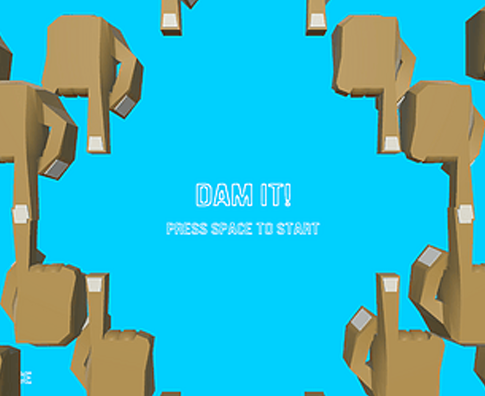
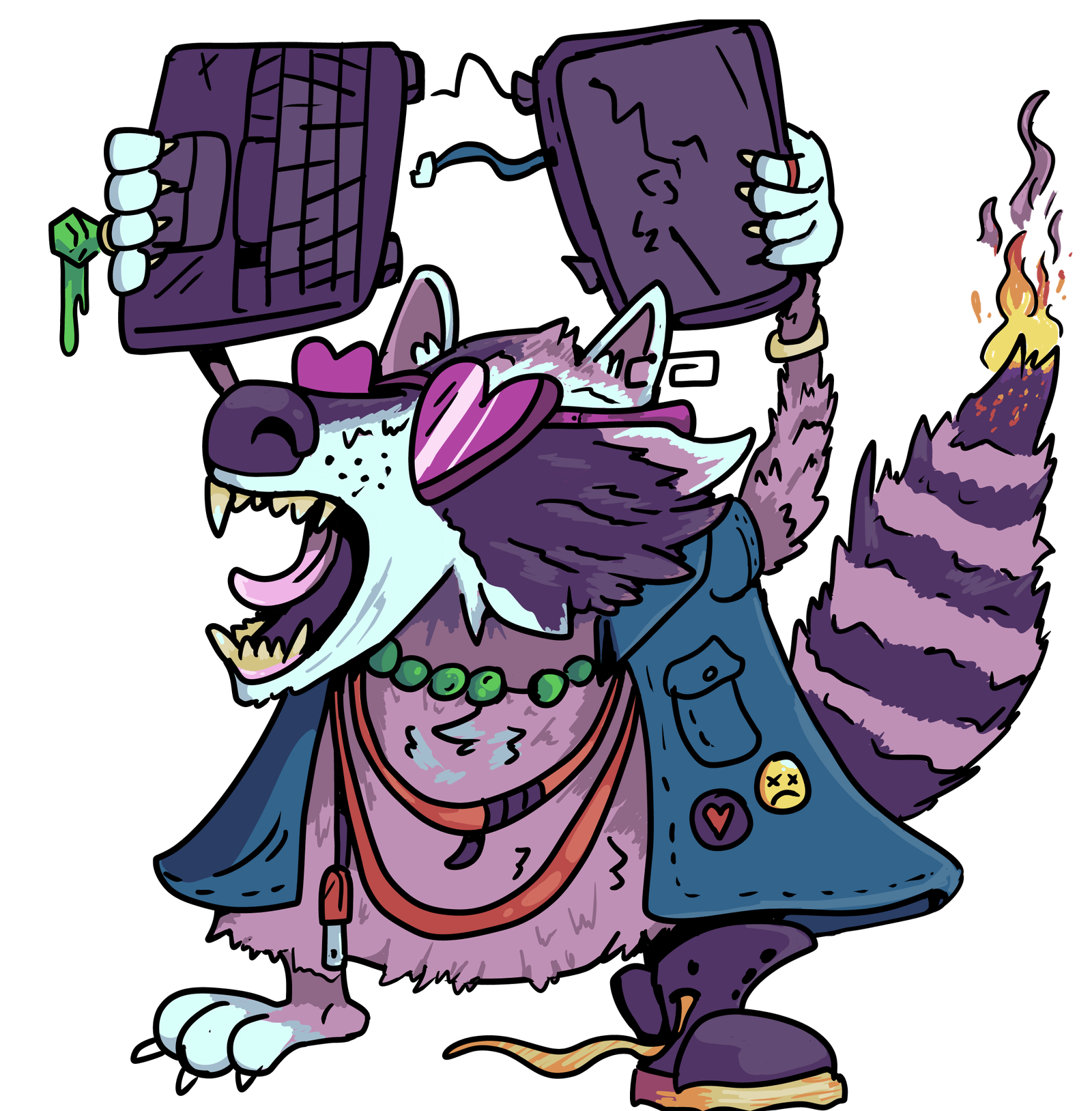
First Place: dam it! by Ian M. Beckman
Seb: How did you get to the idea of plugging holes with your fingers on the keyboard?
Ian: I was really thinking about what I wanted to do for the game jam and I’ve always been really fascinated with input and weird ways you can interact with games. So, I was thinking about it, and I was like, “Well, what if you had to hold down a lot of keys at once? Like what if that’s something you had to do, and what would that look like?”
And then I was like, “Well, what if I had to hold down a Q and a P and a B and a V all at the same time and kind of start playing around with that?” I was like, “Okay, well, that could be something, but how do you frame it?”
And then one of the optional themes for the jams was “constant drain” and so I was like, “Oh, constant drain, you know, what if a dam was leaking or something like that?” It’s kind of a cartoon trope of something leaking and sticking a finger in it and then doing it all over the place and it really all just came together.
I thought it was a good idea, but you don’t really know until you get it in there and you start playing and it’s just immediately like, “oh my God, this is way harder than I thought it was going to be to play.” But it was perfect because you only have under 2 minutes to sell this whole idea. So, it just kind of worked out.
Seb: I feel like the reference of the cartoon trope of trying to plug something that just won’t stop leaking is so perfect, it really shines through in watching other people play. Typing games lock people in, they’re moving fast, but with yours, you end up contorting your hands in deeply unnatural ways as it gets more frantic. It makes for some really great moments watching people play.
Ian: Yeah, it divests from the concept that it’s a keyboard that you use for typing, it’s more, you have this brick of a lot of buttons and don’t think about it as a keyboard, just think about it as I’m telling you which button to press.
Seb: Are there any arcade games that you’ve particularly pulled influence from?
Ian: Sure, I don’t know if you go to Logan Arcade these days, but you’ll play some of those weird games with a ton of buttons like the table flipping game.
I don’t know, any sort of arcade games so often are really specialized to perform within the normal control scheme that has been put out. But no one said that’s the only way you can control games. As soon as you get away from that, it just opens up all these weird ideas that you can be pushing.
I love a good arcade. I used to play fighting games and as a kid, you just have so many buttons and you’re just like “There’s so many, what am I doing,” you know? Just the fun moment of reconnecting in that primal way, like “I am just engaging with this. I have no knowledge of how I’m supposed to do it, I’m just playing.”
Seb: I feel like it lends itself really well to imagining how a dedicated controller could look for Dam It! Just with the variety of buttons, it’s very reminiscent of games like Whack A Mole, the frantic energy around it.
Ian: It’s funny you say Whack A Mole, because one of the comments we used to get all the time when we were showing Cosmo’s Quickstop was that people would say “this is the Dark Souls of whack a mole, just inputs everywhere” you’re just like “go go go go.”
Seb: Do you feel like that’s a through line in your work?
Ian: I do love input, it’s a really fascinating part of games. Something that separates games from other art forms is how you input and receive feedback. I think it’s not explored as much as it could be – obviously there’s hardware limitations, but no one’s decided on this is how we have to do it.
Look at like the Wii or something; they radically changed input and everybody freaking loved it. It lets you take people who don’t know the learned skill sets of how you interact with things, like WASD and mouse movement. You get rid of all those assumed knowledge barriers and then anybody can play it because you’re engaging them on a simple level. It’s not like you need to have played all these other games to be able to play this one, you know?
Seb: Are there any games or creators that you want to shout out right now that you’re particularly enjoying?
Ian: Well, I mean this shouts out your guys’ zine – I was reading the latest edition, and I read all about Buddy Simulator 1984, and I went and played it, and it was a great freaking game, especially talking about games that are doing different things. Like the start of the game, you’re literally typing in commands and stuff and it’s very engaging. I loved it. Really good game. Local Chicago, so I love it.
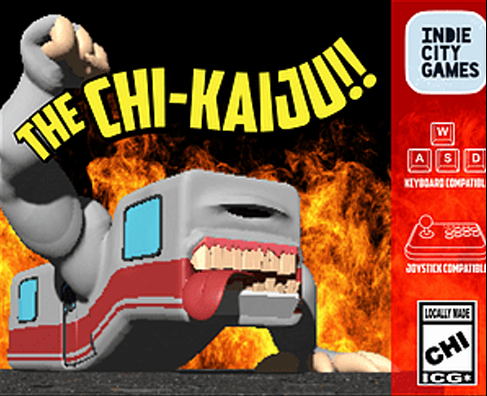
Third Place: The Chi-Kaiju!! by Zach kolman
You were once an elevated train, content to carry your passengers across the city of Chicago. But in 2004, an industrial accident caused you to derail and sink into the Chicago River. The constant drain of chemicals leaking from your corroding engine mixed with the waste from a passing musician’s tour bus, and an unnatural chain reaction was begun.
For many years, you lay forgotten beneath the water… Growing… Twisting… Biding your time… But now your time has come! Bounce back from your watery grave and seek revenge on the city that abandoned you. You cannot, and will not, be stopped.
Crunch their buildings with your mighty arms! Incinerate their roadways with your powerful fire breath! Sweep away the guilty with your merciless tail! Arise now! You are… The Chi-Kaiju!
The creators of The Chi-Kaiju!! brought 3D printed trophies to the All-Stars showcase, wowing players with a tangible piece of their game winners could bring home.
Seb: Okay. So, what got you started in 3D modeling, or I guess 3D printing specifically?
Zach: I started doing 3D animation classes back in high school. It was very informal. It was basically just me and some other students messing around in 3DS Max without really knowing the best ways to use it or create stuff. It was mostly just bashing shapes together and putting JPEG textures onto stuff, but it was really my first introduction into creating 3D objects and making scenes and things in my brain.
I think that was when I was like, “oh this is something that I could actually go to school for, there are majors for this, you can actually pursue this as an education.” I landed on the Columbus College of Art and Design in Columbus, Ohio. That’s where it really started for me in learning proper 3D modeling and being able to create really nice-looking stuff that I can be proud of and feel good sharing and showing off to people.
I think that eventually turned into an interest in 3D printing as well, and this fabrication aspect of things. In 2012 and 2013 a lot of this kind of technology was more niche, but the school I was going to, what you would call a maker space back then, they had 3D printers that were slow as hell. They chugged through material, the quality wasn’t great, but it was still the coolest thing I had ever seen, because I, at that point, had never seen a 3D printer before.
So, I just went on with my education in 3D art and game design, I transferred to DePaul after two years and started my degree in game design and kept focusing on that. I ended up working for the IT department while I was at DePaul, and one of the labs had a 3D printer and I had a couple chances to try making some stuff there. It was a really slow printer. It was really inconsistent when it worked and when it didn’t, but I was able to make some small tabletop gaming pieces.
That was the first time I felt like I was able to make something that had usefulness to it. I have a lot of access to this stuff and can just keep making and experimenting and trying again. And it finally got to the point where I’m like, you know what, I’ve got to just pull the trigger and just get my own 3D printer, so I started with Creality Ender 3 V2. Basically one of the first printers that every beginner enthusiast ends up getting.
There’s a lot of tuning and fist fighting the machine to get it working, I finally had a printer at home that was just at my disposal to do whatever I want, whenever I wanted. And you start discovering that there’s a lot of nuance to making something printable versus something that you can toss into a game engine. So it’s just oh, this model had to be so optimized, if I’m using it in Unity, but with 3D printing, I can use a lot more detail and polygon density and I can really crank out all of that actual physical detail because I’m not worrying about how much it’s gonna bog down the system while the game is running.
I think anybody who tries to start creating characters to make or to 3D print and make as a product, start learning that, there’s a lot of really specific and interesting ways that you go about creating these kinds of things – the orientation of objects and how you split it up. I ended up going and getting some off brand dolls at Target so I could see how the dolls were functioning, like how they made joints so the arms could rotate, and the legs could move and better understand the theory and methodology to creating something with posable joints and it really sparked me as really cool. This is something I’ve always really liked – it’s very tangible to me.
Seb: So this leads us to your moment of triumph, the trophy for Chi-Kaiju.
Zach: Yeah, Chi-Kaiju!! was a 2D game, I’m always open to working on any kind of game, 2D, 3D, but my forte is in is in 3D. When I saw Luke’s sprites that he made for the Chi-Kaiju, I was like, these are so good. I really want to 3D model this.
I think it would be awesome and I have an excuse for it because I made the box art, early 90s CG vibe that a lot of box arts had, like Rampage. And so, I was just like, you know what, I’m just gonna go ahead and just model this guy out and try printing it out. That’s really all there was to it. I was just like this is awesome, I want to take this in Blender, crank it out, and make a little trophy for us.
acknowledgements
I’d like to shout out my former classmate from Ohio, instagram @92alexkim. He was a dope concept artist who let me 3D model one of his mech designs, and that was the first model I really tried to play around with getting to articulate. My music producer friend is also on Instagram, @B0ofo. He asked me to model out his mascot and print a massive 3-foot version of it. Another great experience bringing the character to life through printing.
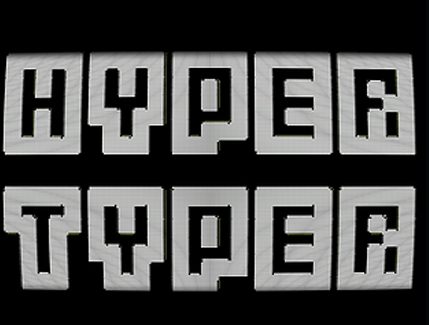
Community pick: Hyper typer by Binary Clone
Seb: Why a typing game for an arcade jam?
Kyle: I wanted to see if I could do it. It’s partially inspired by my split keyboard at home. I’ve played many typing games before and enjoy them. The Textorcist was the only really interesting one mechanically, as it combines typing with movement in a bullet hell setting. This led me to question how many words can be typed with one hand. I wrote a script to parse a word list for left-hand-only words, finding just under 5,000. That seemed enough for an arcade game. I wanted to create a typing game that does something new, allowing movement and typing simultaneously without mode shifting.
Seb: You have an unconventional aesthetic for arcade games. Can you talk about the art?
Kyle: I was inspired by Ace Rolla’s YouTube channel, which explains post processing effects. He released an ASCII shader video, which I modified to keep colors. It was perfect for a typing game, simplifying the visuals while maintaining a distinctive look. The aesthetic serves the game well, making everything immediately readable.
Bullet hells and typing games both need visual clarity, so finding the right balance was crucial. I experimented with different fonts to ensure legibility while maintaining a retro vibe.
Seb: You’re working on a full release. Can you share your plans?
Kyle: The primary focus is cleaning up and polishing the game. I’m improving readability by adding visual feedback, like a laser beam showing which enemy is being destroyed and color coding words as you type them correctly or make mistakes.
For example, as you’re typing, if what you’ve typed matches an enemy’s text, the text above that enemy’s head will turn green. If you make a typo, the whole word will flash red and then fade back to white. This gives players a very obvious visual cue without needing to look away from the action or their keyboard.
I’m planning to add at least three or four new enemies. An important addition will be an assist mode, inspired by Celeste, to make the game more accessible. This could include options like slowing down time or other accommodations to make the game playable for a wider audience. I think this is especially important for a game like mine.
Typing games can be really hard, and most people need to look at their hands when they type. While my game is entirely playable if you need to look down at your hands, it’s really challenging. I want to make it accessible to everyone – I want my mom to be able to play this game, you know?
Seb: When can we expect the full release?
Kyle: I’m hoping by the end of the year. I want to keep to a tighter timeline. I think it would be silly to make a game in two and a half weeks and then spend half a year working on it. I’ve had a short break after the jam, but I’m getting back into the groove now.
Seb: Can you elaborate on the challenges of creating a typing game?
Kyle: Bullet hells inherently have to read super clearly. For this game in particular, the other aspects of a typing game also have to be very visually clear because language and characters we use for typing are complicated, not necessarily easy to read, and don’t downscale well.
When you’re doing a bullet hell game, which already needs to read clearly, combined with a text game or typing game that additionally needs to be read clearly, and those things are overlaid on each other, it inherently makes both of them less readable. Finding the right balance was crucial.
Another challenge is the player’s input field. It’s hard to check when you’re dodging bullets and typing, especially if you’re looking down at your keyboard. It was common for people to type the first few letters of an enemy’s word, make a typo, and keep typing without realizing their mistake. That’s why I’m implementing visual cues in the full release to help players track their typing more easily.
Seb: Any final thoughts on game development or this project?
Kyle: For a jam, you’re taking a lot of shortcuts. There are many things that only just work, but you don’t have time to fix them properly, so you stick a band aid on instead of addressing the root cause of the problem. The full release is about cleaning those up and adding that extra layer of polish.
I think Hyper Typer Arcade ended up being really polished for a jam game, but there’s still room for improvement. The process of taking a jam game to a full release is about refining those rough edges and expanding on the core concept in meaningful ways.