The Neutral Triangle in Action Games: Why Hotline Miami Hits Different
by Kyle “Binary Clone” Lueptow
This article was originally published in Issue 10 of the ICG Zine, December 2024. It was reformatted in January 2026, but has not been edited further.
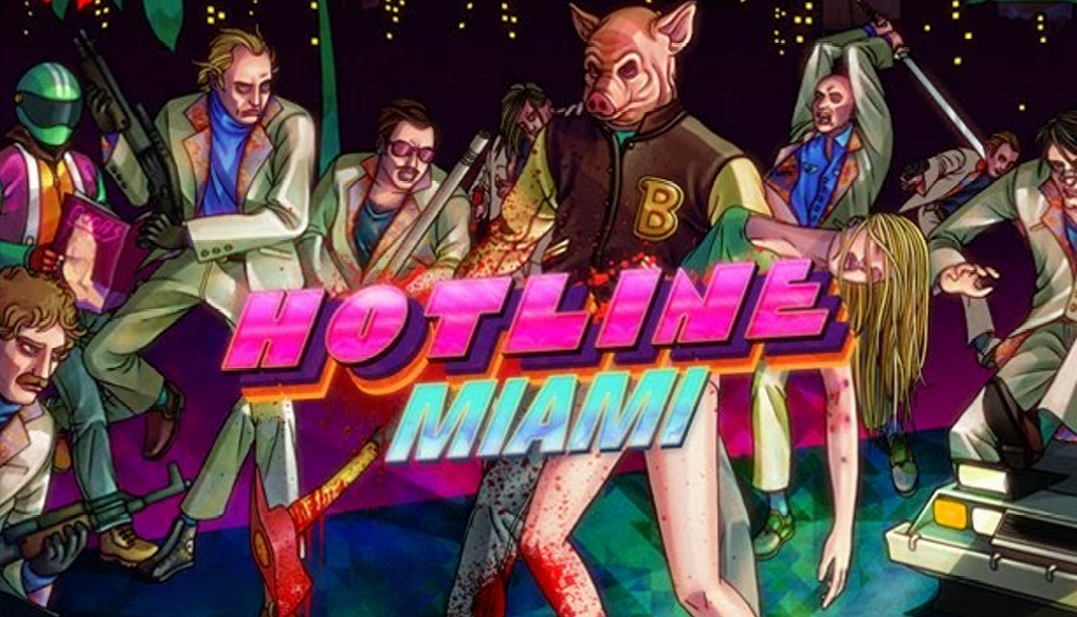
12 years after the release of Hotline Miami, I still feel like there isn’t anything else like it in spite of its popularity and influence. Plenty of games have taken heavy inspiration from Hotline Miami, or are frequently compared to it, but they have all felt fundamentally different to me. From Heat Signature to Katana Zero, nothing has quite hit in the same way. To talk about why, I first want to talk a little about fighting games.
The Neutral Triangle
What I’m going to call the Neutral Triangle goes by a few names – Sajam calls it the 3 Pillars of the Neutral Game, Machaboo calls it “the three structure,” and I’m sure many others have their own names as well. Fundamentally, however, all of these describe something similar. There are many ways to interact with an opponent in a fighting game, but it can be useful to boil much of it down to three broad categories: Reactive, Proactive, and Preemptive.
The simplest category is Reactive. You see your opponent do something and then react with something that beats it. You dodge, block, parry, etc., and turn the situation to your own advantage by whiff punishing or counterattacking. Proactive is the opposite – attacking your opponent on your own initiative. Preemptive actions, then, are based on what you think or know your opponent will do but hasn’t yet. Often this involves predicting your opponent moving in and so using an attack that is bigger and lasts a long time in order to catch that opponent before their offense is able to begin.
These three categories have a rock-paper-scissors relationship that forms the Neutral Triangle: aggressive proactive play beats passively waiting to react to the opponent, preemptive play tends to beat proactive aggression, and waiting to react beats the preemptive attack that hopes for the opponent to rush in.
In multiplayer PvP games, this triangle leads to dynamic gameplay where you must think about your opponent’s habits, their available options, and their expectations of your own actions in order to make the right calls and succeed. However, it’s often challenging to require or even encourage all three of these styles of play in a single-player game.
Playing rock-paper scissors with a computer is a lot less interesting – you can’t condition a computer to think you’ll do one thing so you can catch them by surprise, you can’t catch on to the habits of something purely random. So what do these categories have to do with Hotline Miami?
The Triangle in Action Games
Most action games heavily encourage one or two of these action categories. The Batman: Arkham series is primarily reactive as you respond to specific enemy action cues with counters, stuns, or dodges. The modern God of War games are primarily proactive and reactive – either attacking enemies immediately or reacting to their attack patterns. Most Soulslike games are primarily reactive, centered around good positioning, learning attack patterns, dodging effectively, and whiff punishing when there are gaps in enemy offense.
The above examples represent a clear trend: reactive action is most common, proactive action is fairly common, but preemptive action is generally fairly rare. That’s not to say it doesn’t exist at all in these games, but it generally isn’t the primary mode of action and generally isn’t required to progress through the game.
Hotline Miami, on the other hand, absolutely thrives on preemptive action. Enemies are fast, they kill you instantly, and they heavily outnumber and outgun you. You cannot react to their swings, you cannot react to their bullets, so the only answer is to predict how they will behave and kill them first.
How Hotline Miami Breaks the Rules
One of the core ways that Hotline Miami pushes this preemptive action is how fast the player dies. Of course, one bullet or one swing of a melee weapon from an enemy will kill the player. However, a piece of this puzzle is how Hotline Miami breaks one of the cardinal rules of animation and fairness in games: anticipation, or wind-up.
Generally, it is considered good animation and good game design for enemy attacks to have wind-up, a period, however brief, where you can see an enemy raising their weapon to swing it at you to telegraph their attack. While sometimes this wind-up is very quick, it generally both looks better and feels more fair. After all, how are you supposed to deal with an attack you can’t even see? Without this anticipation, the player feels cheated.
Hotline Miami breaks this rule entirely. In this game, enemies don’t just kill you in one hit, they almost kill you by looking at you. If you slow down the game and watch frame-by frame, you’ll actually see that as an enemy approaches you, the moment you are in their range, you die instantly, without them even moving their weapon. Only then, after you are already dead on the ground, does the opponent hold up their weapon and swing it above your corpse. The actual swing of an enemy’s baseball bat happens visually about 5 frames, or a 12th of a second, after the player is hit.
…And Why You Don’t Care
This “unfairness” ends up serving Hotline Miami’s pushing of the player towards preemptive play. The ridiculous lethality of the enemies means you must become familiar with the enemy’s tendencies to succeed as the game goes on. How do they react when they hear a gunshot? How do they react when they see you? How close can you get behind them before they notice and turn around? How much time do you have before you’re in danger from the next enemy?
At the same time, the game immediately sets your expectations around how it works and equips you to deal with it. It starts you against a limited number of enemies without firearms, and, perhaps most importantly, it gives you the ability to retry instantaneously and without consequence. It reinforces that death is inevitable in this game, it isn’t a punishment for playing badly, it’s simply a part of how the game is played.
The game wastes no time in getting you back into the action, and since most floors likely take only a minute or so on a successful attempt, a death rarely feels like it has set you back particularly far. You functionally have no advantage other than knowledge – you know where enemies are, you know their patrol routes, you know how they respond to sounds and to seeing you.
But enemies are just as fast if not faster, just as well-armed if not more well-armed, and there are a lot more of them. The game forces you to act preemptively, because playing reactively gets you killed (since everyone is too fast and dangerous to deal with on reaction consistently) and playing purely proactively also mostly gets you killed (since you are vastly outnumbered).
What Next?
The trickiest question is then, how do you create a game that highlights preemptive play like Hotline Miami, but isn’t Hotline Miami? That’s maybe beyond the scope of a zine article, but my hope is to illustrate some ideas around what makes this lauded indie gem so unique.
Fundamentally, it is special because it creates so many un-reactable situations, one after another. It is built on a foundational expectation that the player will not and cannot respond perfectly and must instead take the lead with a kind of cautious aggression. The player must learn how enemies react in any given situation and prepare themselves accordingly, anticipating the next move before it happens. But this is a tenuous balance.
The enemies have to be simple enough to predict without being outright predictable – they still have to be interesting to interact with, after all! The game has to let the player make mistakes and learn, guiding the player without letting them get too frustrated. And most of all, it still has to be fun.
Hotline Miami broke the rules to create something special, so maybe we’ll need to find other rules to break to find new fun in the pieces again.