From Silent Hill to Soma & back again: how horror got here
by Jesse Boruff
This column originally ran in Back Alley Games Issue 20, November 2025
In the spectrum of games I play, horror games are somewhat niche. I’m certainly interested in getting the pants scared off me, but I have to be in a specific mood. Or it has to be October, like it was when I noticed that the Bloober Team remake of Silent Hill 2 was made free for some PS+ subscribers.
For me, the Silent Hill franchise is as close to the peak of the horror genre as you can get, so I was excited to see why the remake was so lauded. The answer: It’s literally Silent Hill 2 again. Where a game like The Callisto Protocol only suggests its Dead Space pedigree with sly nudges and clandestine winks, the Silent Hill 2 Remake is its pedigree.
The team seldomly does anything wrong (or even differently) in the remake. Hell, even the new endings are thematic and pretty great. Suffice to say, I was surprised by how good it was. But why is that? It’s Silent Hill 2, I should be expecting greatness.
Well, considering the modern evolution of horror games that led up to both the original Silent Hill 2 and the remake, there was cause for concern. Despite how much people love the genre, there’s no doubt that many modern entries feel stale, same-y, or uncreative.
I believe numerous factors contributed to first, a formulaic era for horror games in the Triple-A space, and second, following that, a surge of hyper-experimental horror that has now caused a major renaissance of the genre and maybe even a hyper inflated market of horror games.
Let’s start with the camera.
When Resident Evil 4 (2005) shifted its PoV from fixed camera angles to an over the shoulder, third person view, it marked a shift in the Resident Evil team’s design philosophy. No longer would players feel completely helpless as they desperately (and clunkily) maneuvered their character away from foes to reload their pistol. Instead, a few quick turns followed by well-placed shots to enemy weak points oftentimes allowed for (admittedly) badass execution attacks.
This shifted the playing field for horror games at the time, as the helpless feeling that made the survival horror genre so iconic started to take a backseat to action gaming power fantasies. To clarify, it wasn’t Resident Evil 4‘s fault, a lot of weird stuff was happening in the games industry back in the 2000s, but it’s still worth noting.
Then in the 2010s, it was common for Japanese video games to be lambasted by western gaming journalists who took themselves too seriously – notably, X-Play was particularly racist about it – which made major industry figures felt incredibly scorned, and with damn good reason.
Monolith Soft’s own Tetsuya Takahashi said in a 2012 interview that JRPGs had “become a form of mockery,” and Final Fantasy XIV steward and Final Fantasy XVI director, Yoshi-P, once requested in a SkillUp/Gematsu roundtable they not call Final Fantasy XVI a “JRPG,” explaining that he considered it a “discriminatory term.”
This sentiment wasn’t exclusive to the JRPG scene either, as more and more Japanese developers moved to the set piece-driven, action-oriented titles that the west was and is well known for. That’s why games like Square Enix’s MindJack (2011) and the action-heavy Resident Evil 6 (2012) seemingly exist, as attempts to appeal to western gamers.
With Resident Evil being one of horror gaming’s icons, shifts made to its formula were not felt by it alone, but also by others making horror for the Triple-A market. It’s for this reason that I bring up the western criticism of Japanese games. I feel it’s an understated but major factor in the continued homogenization of the horror genre in the 2010s.
Besides Resident Evil, one other series would follow the trend I like to call “Rambo horror.” Dead Space 3 (2013) feels more like a zombie-flavored Gears of War than a horror game. I would cynically venture a guess it was another victim of trend-chasing corporate mandates.
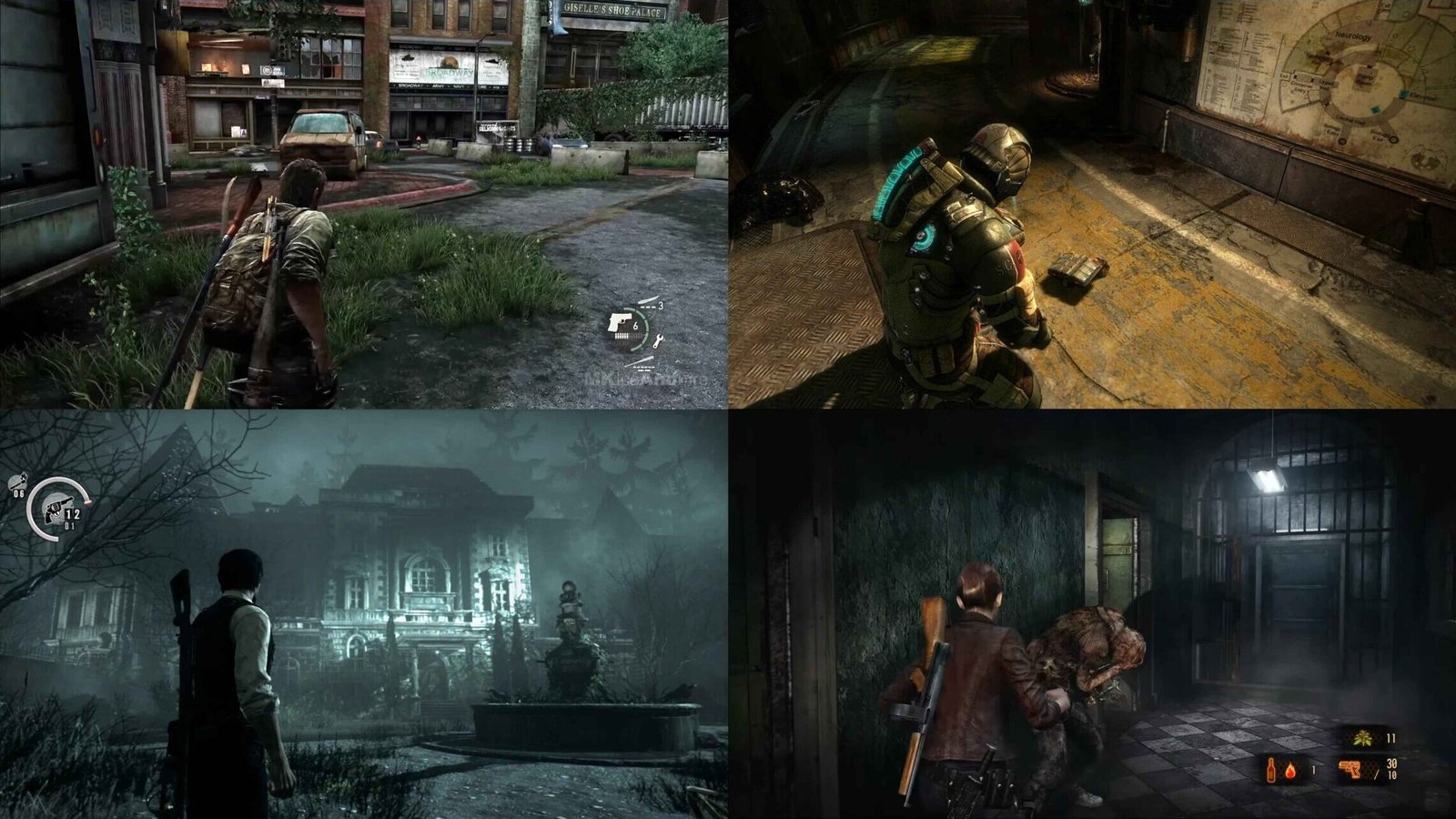
In fact, a vast majority of the survival horror games of the 2010s became third person, over-the-shoulder action affairs. Alan Wake (2010), The Evil Within (2014), and The Last of Us (2013) –it totally counts– look so similar that at a glance I genuinely can’t tell which game is which when they’re placed next to each other.
Do not misunderstand, I am in no way saying these games are bad. I’m a huge fan of each of them, truly. I just find that industry trends are usually followed to the detriment of the final product. For years this persisted and the same kind of games would be made. Alone in the Dark would receive yet another misguided remake in 2015 and Konami would desperately pitch the Silent Hill IP at any western dev willing to bat.
Growing up in the 2010s, you had to look elsewhere for those horror games that’d keep you awake all night. You’d find some really interesting ideas on what horror could be, things that were barely finished, and things that would change the genre forever. When Triple-A gaming started to lose the plot, indie devs and small studios started emerging as the No. 1 place to get your scares.
I don’t have a specific game I can point to as where this all started, but there’s a handful of indie titles that I think contributed greatly to the modern horror scene. Games like Limbo (2010), a short affair that terrifies and delights with its own uniquely brutal style. I credit Yume Nikki (2004) with introducing liminality and abstraction to many audiences, and Soma (2015), with being a deep introspective look into existence and personhood, all while managing to be scary.
It also can’t be taken for granted that Five Nights at Freddy‘s simple concept of protecting yourself in an armored room from psychotic robot bunnies and bears was enthralling at the time. Even Friday the 13th: The Game and Dead by Daylight‘s multiplayer spins on survival horror were innovative and fresh.
A particular subset of horror games I find fascinating for its influence is RPG Maker horror, some of the more popular examples being games like the aforementioned Yume Nikki, Ib (2012) and Mad Father (2012). Japanese gamers had been making horror experiences in RPG Maker for some time, the engine proving quite capable of delivering some impressive and oppressive atmospheres. Building off that precedent, current RPG Maker favorites like Look Outside (2025) and Fear and Hunger (2018) have gained massive acclaim and notoriety for the brutal and disturbing imagery they contain.
Of course, outside of RPG Maker, the indie scene has been at it, too. Boot up itch.io and take a look at all the horror games. This itch.io indie scene spawns games like salmon spawn their young. Series like Garten of Banban, one-off horror experiences like the Puppet Combo games, and Atari-esque satanic horror of the Faith games, the scene has it all.
The multiplayer horror fare is also positively inspired. I had never seen a game like Lethal Company or Phasmophobia before 2020, and their popularity has led to multiplayer horror games becoming extremely prominent with titles like Dead by Daylight and REPO.
Truly, indie horror games are alive and thriving in the modern era. It also honestly didn’t take long for developers outside of the indie scene to look at this era’s success and want a piece of that pie.
When the Triple-A scene started to wake up and smell the coffee, it was a bitter but welcome brew. Developers of games like Alien: Isolation put some “survival” back in their “survival horror” games, with Isolation being one of the most pants-shittingly terrifying games ever made.
FNAF, which at this point has become a Triple-A IP, also bucked its original formula in Security Breach, instead opting to follow a young man as he breaks into Freddy’s Fun Land, a Chuck E. Cheese of sorts. The return to form that is Resident Evil 7: Biohazard also saw a release that felt like a love letter to the old games in the series. Even Alone in the Dark resurfaced in 2024 with a more traditional feel.
Now, as I write this, we’ve received two fantastic Silent Hill titles in Silent Hill F and the Silent Hill 2 remake and Resident Evil has been on a roll with remakes and new titles galore. Horror is seeing a renaissance of sorts, and devs are becoming more and more comfortable with scaring their players outside of the horror genre as well. I’ll never forget the first time I was chased by the tar demons that are the BTs in Death Stranding. As their wails erupted forth from my sound system, I lost it a little.
The state of the gaming industry at the height of the dude bro Xbox 360 era had me turning to the internet for my scares. Now, it seems those very people who had busted their asses to create immaculate indie experiences are now the guys making remakes of classic horror games. The genre has seen transformation after transformation, new era after new era, and for so many talented people to be working in the same field, for the same genre, is mind blowing. We should count our blessings – or our curses – for that.