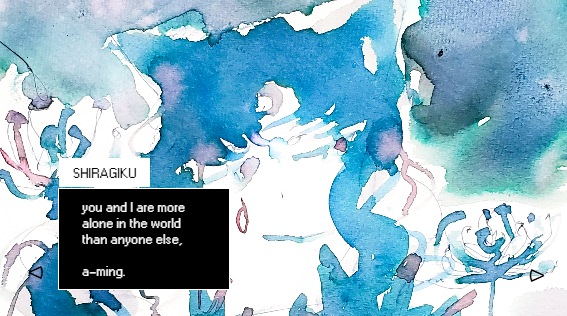
REMORA
by Back Alley Editorial team
This article originally ran in Back Alley Games Issue 16, June 2025
Disclaimer: The game detailed in this article tackles topics of homophobia, child sexual abuse, overt violence, sex work, and suicide.
Any true crime fanatic will tell you that they know what it takes to make a sociopath. They’ll rattle off sentences from the DSM and gesture vaguely to figures like Jeffrey Dahmer or Ted Bundy.
Swanchime Thien is different. She doesn’t try to hide behind clinical language or cold, disapproving distance. By their own admission, her games are all attempts to humanize the sociopath.
“A sociopath was once a child whose humanity was shattered in the cradle,” Thien said. “The theme of all my games is to humanize the extremity, severity, and atrocity it takes to create [that] sociopath.”
REMORA, their most recent project, is a queer visual novel with dark fantasy elements and both transgender and sapphic characters. It doesn’t have choices, instead choosing to decentralize the player in a bid to make them feel helpless.
“The player, similar to the audience [of] a stage play, is helpless to watch the predestined narrative events occur,” Thien said.
This actual helplessness is a bit of a departure from Thien’s previous work. One of his previous games, Kimono (2023), is a visual novel based on Jujutsu Kaisen, exploring themes of gang violence. That game has choices but still may leave the player feeling helpless.About that game, Thien said: “Kimono is about breaking down assumptions [and] paradigms that function for most people, even most mentally ill people, but not for everyone. You cannot apply the rules of the world above to the world below. The filth of society are still human, after all things.”
REMORA, by contrast, is a more straightforward love story set on a college campus. The main character and their best friend just so happen to be sociopaths.
Produced for DevTalk’s first annual Sealed With A Kiss Jam, Thien worked on REMORA for six weeks straight, putting in work daily. The project was entirely produced in Tuesday JS, a visual novel engine that creates mobile- and PC-compatible web-based games. The engine is even usable on mobile devices.
By Thien’s own admission, there was no pre-production or revision phase for this project.
“I have an OCD-based perfectionist complex,” they said. “My creative process is based [in] a kind of ‘do or die’ Russian roulette mentality where I basically create art like I’m being held under the gun.”
They even likened their creative process to a compulsion, something that they must do to prop up their mental health, which they described as “fragile.”
“I create art games almost as if bound by a will that is not my own,” Thien said. “Making games becomes this kind of ritual that I cannot resist in any way, shape, or form.”
For this project in particular, Thien was in a difficult headspace due to some C-PTSD triggers, though she said working on the game was “more therapeutic than Actual Fucken Therapy.”
Thien treats creating these games as a necessary part of her life, something they must do in order to remain alive. They compared their work to a pearl, precious to all but the oyster that created it.
“I make them [my games] regardless of if anyone plays or understands them,” she said. “I am bound by Celestial forces to keep making them if I want to remain alive.”
As for what the audience takes from her games, Thien paraphrased “The Little Prince”:
“I would ask that people don’t read it carelessly,” they said. “When people read it, I want them to look with their hearts because what is important is invisible to the eye.”
Play REMORA here: https://swanchime.itch.io/remora