Halfway between Pokémon and Shin Megami Tensei
by Jesse Boruff
This column originally ran in Back Alley Games Issue 21, December 2025
As I’m sure plenty are aware, Clair Obscur: Expedition 33 decidedly swept this year’s Game Awards, what with its impeccable voice cast, unbelievable music, and interesting parry- and dodge-based combat. It is a true passion project brought to life by people who believed wholeheartedly in the vision.
That being said, what if I told you there was another game that came out this year with an amazing art style, fantastic VO, and a gameplay loop that is as addictive as it is intuitive. Coming out after years spent in development hell, Digimon Story: Time Stranger released in October of this year to very little fanfare. Oh, and it’s my pick for game of the year.
Boot up your Digivices and dive into the digital world with me, and I’ll tell you why.
Rookie Stage: A brief history
The Digimon Story series has been a long-running one. The first I can remember playing were Digimon World Dawn and Dusk (2007) on the original DS, which mimicked the Pokémon dual-version strategy. I remember them fondly as cool little games with plenty of recruitable Digimon to mess around with, but not much else.
A bit after that, we saw the release of Digimon Story: Cyber Sleuth and its sequel. I adopted those games near-instantly and dropped off of them just as fast. It wasn’t that they were bad games, far from it. I suppose there just wasn’t anything that grabbed me in either title.
So, when I found myself staring at a full price Amazon listing for Time Stranger, the latest in the series, one would assume I’d pass on it in favor of Pokémon Legends Z-A, the surer bet. Instead, a force consumed me, and I dropped a full $70 on a game I was pretty sure I’d bounce off within a week.
150 hours of gameplay later, that couldn’t be farther from the truth. Not only have I finally found a Digimon game that truly captured me, but I had also found my game of the year. And yes, I’ve played through Expedition 33.
Champion Stage: The Digi’s in the details
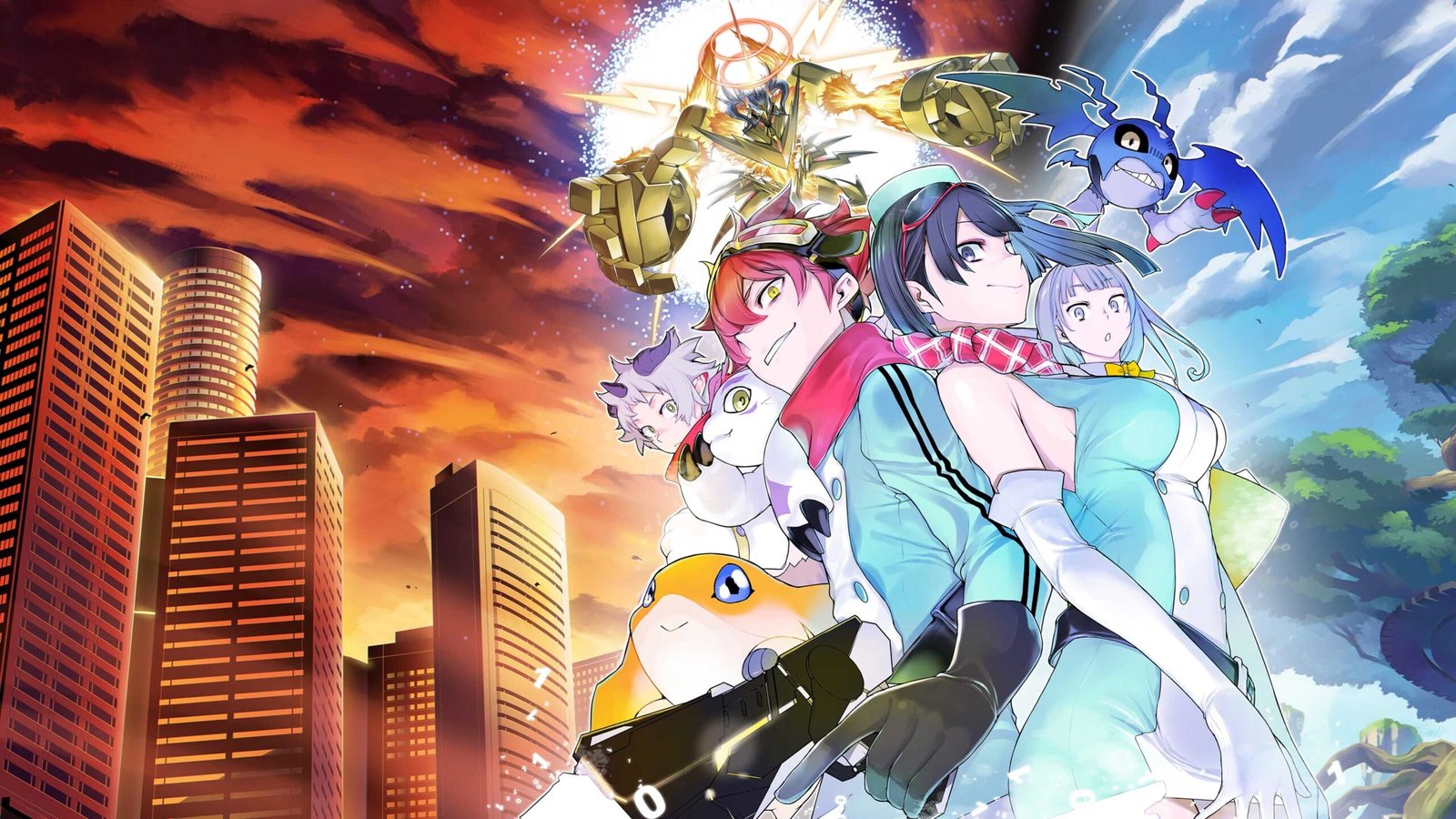
The visuals of Time Stranger are unreal. Within the first hour, you’re treated to beautifully rendered images of hyper-violent hulking creatures laying waste to the earth, shooting vibrant beams of destructive purple light from forms that barely resemble Digimon.
In the middle of that action, you’re given control of a character you know nothing about by a game that refuses to hold your hand. All you know is that you’re employed by an agency that aims to protect the world, and that a handler calls your phone with meme-like frequency to yap about current events, the mission, or your father who mysteriously disappeared years prior.
You get your first Digimon soon after you get control, which is similar to previous titles in the series, but unlike those games, I wasn’t stuck in a blue-drenched Cyberspace world. I was actively exploring a collapsing building, battling creatures, and summoning new ones. As the game progressed, I was continually impressed by the art style and locales in the prologue, but my jaw didn’t truly drop until the title did.
You’ll be a good 5 to 10 hours into the game, depending on how much monster battling you’ve done, before you see the title drop. Pacing like that is always a treat; it’s as if the game is saying: “you’re in it for the long haul.” Once the title does drop, though, you’re treated to the most impressive visuals yet. It looks like a Ghibli movie. Truly!
It was amazing watching all the Digimon go about their daily lives, floating above you, carrying on with their own tasks and routines. The world is littered with small details to the point it became slightly overwhelming, and those details are constantly changing. As the game progresses, including through unbelievably artistic and emotionally resonant shadow puppet cutscenes, story events leave their mark on the landscape permanently.
Ultimate Stage: So, how does it play?
Once the ability to evolve Digimon became available to me, I started doing what I always do, connecting a new game I love to games I’ve loved before.
Of course, Pokémon comparisons are impossible to escape for any Digimon game, but I feel that the Digimon Story series sets itself apart fairly well. You aren’t capturing monsters, instead battling them repeatedly to gather their data, which seems pedantic, but the difference matters.
Once you reach 100% sync with a Digimon, you’re then able to summon it. For example, let’s say I spent a good amount of time beating up Agumons. Every KO earns me 20% sync, so once I beat five and hit 100%, I can summon an Agumon, or I can battle five more to overcharge to 200%, giving my eventual summoned monster a big stat boost.
This system is genius, as passive play earns you the game’s main resource. It takes away the feeling of grinding from the grind, instead making progression a byproduct of experiencing the game and its story. There were multiple times that I’d finish up a long dungeon only to open up the sync menu and find that I could summon a ton of Digimon to either evolve or feed to my other Digimon.
Those systems also kind of feel like a send up to Shin Megami Tensei, as the demon recruitment is also well integrated into the world of those games. The evolution menu even kind of reminds me of the fusion menus in a lot of SMT games, hiding their creatures behind silhouettes.
Evolution remains satisfying in this entry, as well. There were a few times I evolved a Digimon and was weirded out by the evolution (Beelzemon and Gallantmon come to mind, looking more like Personas than Digimon), but for the most part, Digimon designs are timeless and pretty badass.
To be clear, I know I’m making a lot of comparisons, but the design language of Digimon is maybe one of the most unique I’ve ever experienced. You have ridiculously silly designs like Deputymon – a cowboy hat-wearing, dual gun-toting, humanoid revolver – juxtaposed against numerous Digimon that are evocative of Greek myth. It feels like the midway point between SMT and Pokémon, with your mascot-like Agumons positioned right next to monsters like Plutomon. It’s hilarious to see cute little Gatomon standing next to a massive creature like Wendigomon, who, if you watched the ‘90s Digimon anime as a kid, you’ll cringe at the sight of.
The story also caught me by surprise, becoming a sprawling, time-spanning epic. Your companions have some very interesting storylines and developments, too, with my favorite being Aegiomon. I often found myself wondering what could even happen next, and not once did I skip a cutscene.
Mega Stage: Why you should pick this one up
The vision of this game left me flabbergasted. Everything in it is either in service of the story or of the player’s overall experience. You may never be expecting to cry over a giant pink snail dinosaur and their little blue fish friend’s Romeo and Juliet situation, but it just might happen if you play this game. Hell, the theme of the game might as well be “tragedy and recovery,” as numerous Digimon have surprisingly well thought out personal stories.
Not only did Time Stranger help me reconnect with a franchise that I quite enjoyed as a youngin, it also got me to pick up more games in the franchise. I’ve given Cyber Sleuth (2015) and Hacker’s Memory (2017) another chance, and I’ve gotten farther than I’ve ever been before in those games.
It’s a testament to the director of this game that even through an eight-year stretch of development hell, they were able to release an impeccable piece of work that really struck a chord with me. When I return to the digital world of Time Stranger, I plan on running it back on the hardest difficulty with all my beefed up Digimon, something I never do. It goes to show just how badly I want to stay there and never leave, I suppose!
If you were on the fence, the game has seen a few sales since release, and it will only get cheaper as time goes on. So, if you’re not like me and are good with your money, you’ll have ample opportunity to pick the game up. Heck, I paid 70 bucks for it, and I would still say my money was very well spent.