Hello Again interview: April 2024
by Seb Galvez
This article was originally published in Issue 2 of the ICG Zine, April 2024. It was reformatted in November 2025, but has not been edited further.
Hello Again is a time-looping adventure game set on an island filled with ancient ruins. Explore abandoned structures, solve clockwork puzzles, and befriend quirky characters to uncover the island’s secrets and break the loop.
The following interview is with Dwight, the game’s developer.
ICG: What went into making the decision to overhaul how the game looks?
Dwight: I think it is the nature of game projects to change constantly, especially personal projects where there’s little external pressure forcing you to make the game be a particular way. The only constant thing about this game project so far has been how wildly and frequently it has changed.
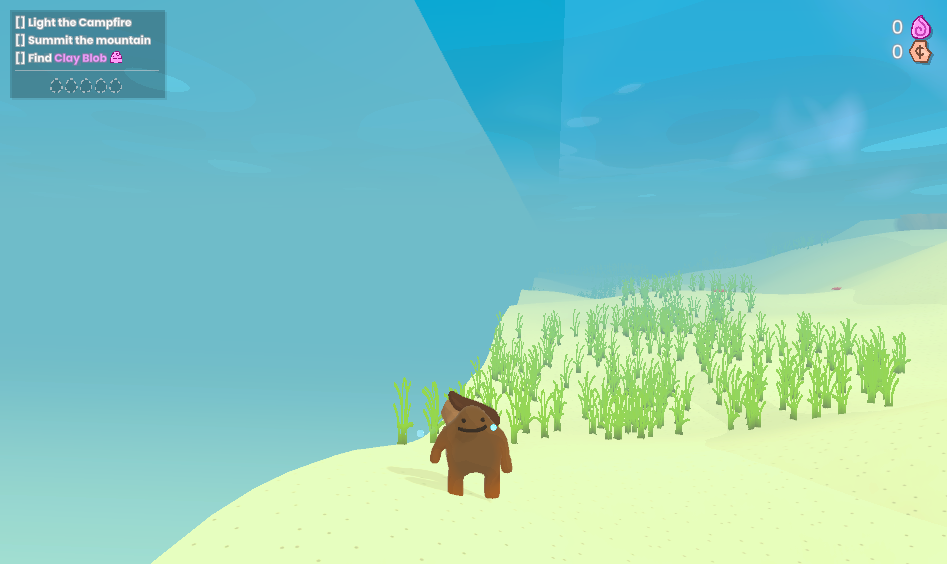
The most significant changes that I overhauled were the cast of characters, adopting a new visual style for the character design, and new style choices for the overworld map. That was born out of growing dissatisfaction with previous art and my ability to make art better now. It was also in response to feedback I’d received from publishers and from other folks about the look of the game and the realization that the game as it is right now is still sitting in a pretty low wishlist count.
That simultaneously means that maybe some things should change in order for the game to start picking up that word of mouth spread that I’m looking for. This is like Indiana Jones sliding underneath the door, this is my last chance to make big changes before pushing harder on marketing and trying to get it in front of people.
ICG: Why not test the market more before making a big change like this?
Dwight: Something that’s been a guiding star throughout this process for me is that it’s not really a full overhaul in any sense of changing the style. I feel I understand the style better now and I finally had a wakeup call to really try and execute that style to the greatest of my abilities now that my abilities have increased over the years. I would say that the visual changes I’ve been working on really are getting me closer, and always to the original ideas behind this game, instead of pulling me further away from it.
ICG: Do you have any goals for Hello Again?
Dwight: Talking to the Indie City Games community, so many people are in a similar place of being creators who want to make something simply because they love the act of making it. So I think a lot of people could resonate with me in that my main goal for making a game is just to enjoy the process of making that game. That feels fulfilling, it feels exciting, it gives me a good kind of stress and tiredness that will fill up my life over the course of several months or years.
In that case, every day that I work on the game, I’m fulfilling my main goal for it, which is just to be a person who makes games and to do that through a game of my own. I think my goal is that as I am trying to tell a story and create a gameplay experience that I would find fun. I know there are other people like me out there, and I want the people who find similar things enjoyable to me to enjoy this thing with the goal of just making their lives happier and better by giving them a memorable experience.
ICG: How has pitching to publishers gone? What are the highs and lows?
Dwight: I am a solo developer on a one man team, who has never really had anybody else on this project. I make this game, typically, at a pace of about 15 hours a week in the cracks I find in my free time after I finish up my 40-hour a week job as a game developer. That doesn’t leave me with a whole lot of extra time or energy to shoot for extracurriculars with this game, unfortunately.
So I had no intentions to find a publisher for Hello Again. I had a publisher reach out to me after I submitted Hello Again to Steam’s Next Fest. I learned a lot. I was lucky that the publisher who approached me were really great people who I think really wanted the best for me and my game. Although spoiler alert, we weren’t able to find a deal.
But I did learn some important lessons, I learned that the amount of production and admin work that it takes to get a publishing deal going is significant. If you’re going from being fully solo with no plans of a publisher to getting yourself publisher ready, that can take literal months of your time. Another truth that pairs well with that: there is absolutely no guarantee that a publisher deal will turn out until you have a signed contract.
So I think it’s a bit like going to a casino or playing the lottery. So I would caution people that if you’re in a position where you can handle the things that a publisher would do yourself, if you have the time and energy for it, then there’s a good chance you might not need a publisher. If you are in a position like me where it would be great to have publishers and allies in your process, just keep in mind that the process of developing a pitch, having follow up conversations, sussing out whether a publisher is a good partner, and then actually, you know, figuring out how to fit your game into their release schedule is exhausting, takes a ton of time, and can fall apart at the last second. Still worth it. But I wished somebody had thrown that huge asterisk in my face before I had started on all of this.
I wish I could just say you don’t need a publisher. The truth is publishers are here for a reason. Not every publisher is some bloodthirsty vampire out to take advantage. There are some truly wonderful people out there who just want to help devs make games, but they’re doing it under extreme pressure, and they don’t have freedom to do whatever they want. Be really careful.
If you are talking with publishers, make sure you’re with one of those folks really in it for the right reasons who care about you, will ask you questions, and who will put up boundaries to make you still feel like you are piloting the ship, to the degree that you’re comfortable with. But there’s great deals to be had out there. And who knows what’s in Hello Again’s future! I don’t have plans to go pitch to publishers again, but I wasn’t expecting the last round. So maybe there’s something I’m not expecting coming up.
ICG: What inspires your game?
Dwight: I do enjoy the movie Groundhog Day. And my ideal version of this game is one that has some slight references to Groundhog Day, Bill Murray, and the plot of that movie. I find that a lot of the characters in this game are based off of D&D characters that I’ve played. Their personalities I find very easy to get into the heads of and therefore write for them. Some of them even share the same name as they did in their respective D&D campaigns.
I am also just a fan of cartoons, and big, silly energy wherever it can be found, and I am thinking constantly of how to make this game capture that big silly energy in a way that will make people smile. Life is too small and serious. We need it to be bigger and sillier.
ICG: Do you have any advice for other game developers?
Dwight: We talked a lot about how Hello Again has changed over the years and as game developer it’s easy to feel a lot of insecurity about doing things or about how your project works, does not work or stays the same, and there can be some shame when you think you made the wrong choice or don’t like a decision you made earlier on.
The world is full of landmines to make creative people question themselves, so if there is one thing I could say to myself and other game devs is that there is a ladder from going to zero experience to being an absolute genius and no one gets to the top without stepping on every single rung. So there is no such thing as an impostor or being bad at game design.
If you’re ever in a place where you’re feeling self-conscious about your games or skills, I find it helpful to remind myself that mistakes and making shitty projects are all just going through the steps that are required in order to get good at something. I really like to say this in order to remind myself I’m not bad at doing what I’m doing, I’m simply going through the steps that everyone has to. That’s been a powerful message for me and helps fight impostor syndrome.