Notes from development: Elemera
How a fan project became a sprawling online monster catcher
by Nick McKay
This article originally ran in Back Alley Games Issue 11, January 2025
It’s no secret to anyone who knows me that I’ve been working on a game called Elemera. It’s something I take every opportunity to talk about, something I’ve already sunk years of my life into, and something that some members of Indie City Games have already contributed to.
It’s safe to say I’m very passionate about it.
Unofficially, work started on Elemera in October 2022 after the success of PokéWilds, a fan project I was involved with. Originally started as the personal project of a programmer going by SheerSt, it had attracted a fairly significant team by the time it exploded in popularity in mid-2022.
PokéWilds was a top down 2-D open world Pokémon game built in Java with a distinct Generation Two aesthetic. Its popularity forced me and the rest of the team to pump the brakes on the project in fear of a shutdown on copyright grounds.
During this period, I asked Sheer as well as some other team members if they would be interested in starting a new studio centered on our own IP. Many were eager to work on this new project, and so work began on what we would refer to as Project: Living World.
Early development included a long stretch of time where we focused on identifying the aspects of Pokémon and our other previous projects that inspired us. Many portions of PokéWilds were arbitrarily chosen or were relics of its past as a fan project and so were thrown out.
By mid-2023, the game was completely unrecognizable from either Pokémon or PokéWilds.
From the start, development was full of twists and turns. The engine was switched twice, the team grew from six members to 30 (some of whom are distributed across the world), and we incorporated as an LLC.
It’s been an eventful process I can’t fully cover here, but I’ll share a few important moments.
We settled on the name Elemera in March 2023. The name is a portmanteau of element and chimera (or alternatively, element and era) and conveys the difference between our project and Pokémon fan games.
When trying to decide on the name for the project and the creatures themselves, we checked every combination of element and monster we could think of. Then we tried variations on the same theme in other languages, eventually landing on Elemera.
In October 2022, we designed our first “mon.” Molk, one of our artists, dubbed the creature “Roaming Giant,” but we would refer to it most often as “the Behemoth.” It would be a keystone species to a forest biome by consuming large swaths of trees and tilling soil in its wake, allowing new life to flourish.
Ecosystem design was focused on the involvement of each and every elemental creature. They would not simply exist and consume foliage or attack other creatures, instead leveraging their unique physiologies and abilities to impact the world around them.
After the design of the Behemoth, our artists PetraSaru9 and sun_dew designed our player character, which does not have a name as of now. We call the species “The Gardeners” and designed them to feel both mysterious and cute.
I may write in the future about the unique programming and artistic hurdles that our team has overcome thus far in development, but this time, I’ll leave you with this:
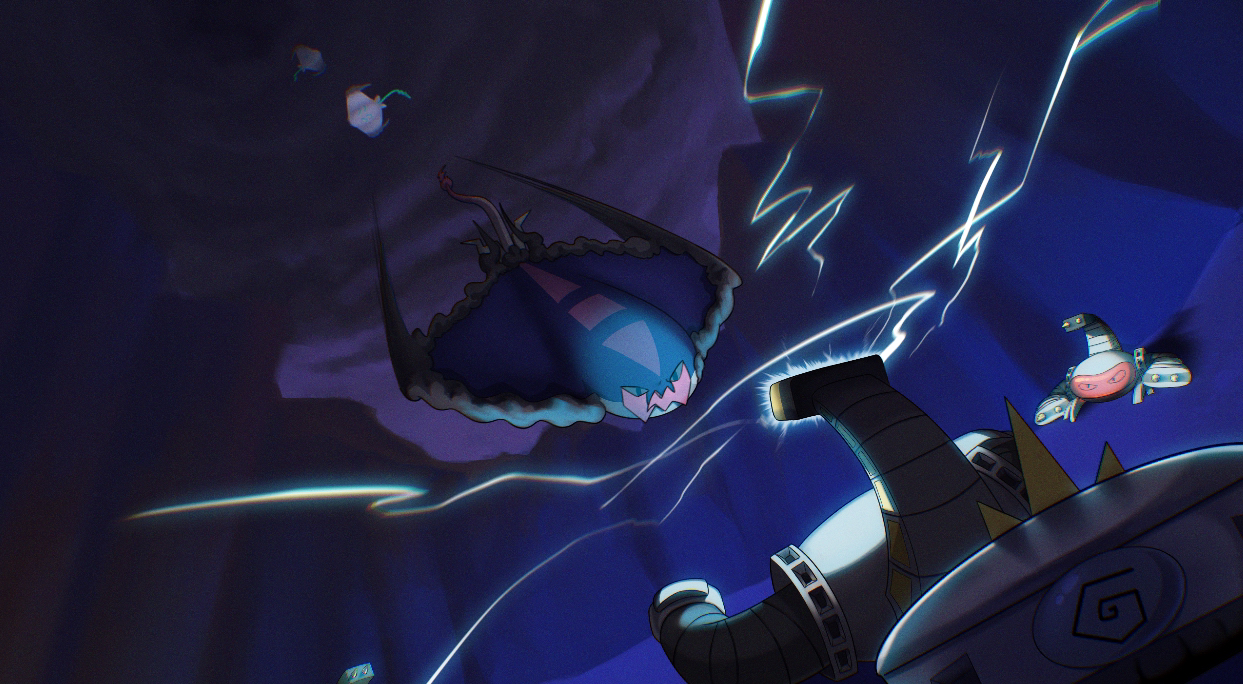
This article began with a scene from our pitch deck of a robotic scorpion Elemera squaring off against flying manta rays that kick up sandstorms. That scene isn’t quite what it seems, but I’ll save that explanation for another time.
Elemera hasn’t been released yet, but you can track its progress and sign up for the mailing list at their website.
This article was submitted by a member of the Back Alley Games community and was edited for publication by our staff. Opinions and thoughts expressed within are not those of Back Alley Games.