Uncle Henry Isn’t Home: Creating a full audio experience for a jam game
by Dani Orizaba
This article originally ran in Back Alley Games Issue 20, November 2025
Uncle Henry Isn’t Home was one of the standouts of Chicaghoul 2025, a real deal point-and-click adventure game presented in an arcade cabinet and capturing the existential, lonely horror of both games like Myst and H.P. Lovecraft’s mythos. – Back Alley Games Editorial Team
I’m writing this to document my process for creating and implementing the audio for Uncle Henry Isn’t Home. I had a blast working on this game and I really feel like I honed my audio abilities in a way I haven’t quite experienced before.
For this game I did every audio thing we could think of: music, voice lines, and sound effects. All of the music was written and produced by me, and all of the sounds and voice lines were recorded and processed by me. I used every ounce of musical and production and recording knowledge that I have, and I’m excited to share more about the journey.
Pre-Jam Rehearsal
To prepare for the jam, I made something like 20 different track ideas over the course of about two weeks. They started just for fun. I had gone back and listened to a track I had made for Charles Voita’s Lookers (2024), which was atmosphere horror-y, and I remembered how much fun I had exploring those emotions musically. And I figured, it was almost October, I should do something to get in the spirit of the season.
So, I made a couple spooky sounding tracks. I had recently began experimenting with microtonal music, and I figured with the dissonances and strange harmonies found there, a spooky vibe would be a fun way to explore these alternate tuning systems.
At some point during the making of these songs, I started thinking of Chicaghoul coming up. I originally wasn’t planning on participating in this jam, but the idea of working on a horror game grabbed me.
I’ve found in the past that I work best when I’m directed by someone with a strong creative vision of their own. I ended up finding that with my team. Seren had the core idea that the game was built around, and I was intrigued, so I joined the team.
Recording Stuff
There were four recording sessions throughout the jam: sampling a mountain dulcimer, recording the voice acting, and two sessions of recording sound effects.
The mountain dulcimer was a stroke of luck. I know someone with a mountain dulcimer AND they happened to be in town during the jam AND they brought their mountain dulcimer AND they let me borrow it for 24 hours.
I recorded every note individually and loaded them up in a sampler so I could play it off my keyboard or by entering notes manually in with my mouse. Those samples became the main melody for the exploration theme and the credits music.
The first sound effects recording session was me recording random things around my apartment. Since I don’t have a field recorder, I set up two microphones on mic stands and moved them around the apartment, my laptop and audio interface (and associated cables) trailing behind.
From these sessions, what ended up in the game was a light switch sound (the lock puzzle clicks and new log entry click) and the door sounds.
Up next was the voice acting session. About halfway through the jam, I recorded Seren’s husband, Jordan, performing the lines Seren had written for Uncle Henry. We recorded 10 “regular” lines and then one line for the distorted section at the end.
For the distorted section we recorded multiple takes of both Seren and Jordan saying the line in vague unison, including takes from Jordan with an Irish accent and a take spoken in French.
Finally was the second sound recording session. During the jam I was also lucky to encounter a really squeaky wooden floor, and the owner of that floor let me come over and record it! They had a field recorder and a nice microphone, so it was a much easier time going around and recording sounds. We recorded more various household sounds. The sounds from that session that made it into the game were the footsteps and the oven door.
Microtonal Music
Heads up: this section gets into very light music theory and goes pretty in-depth about microtonal music. I tried my best to write it in a way that makes sense for people who don’t know music well.
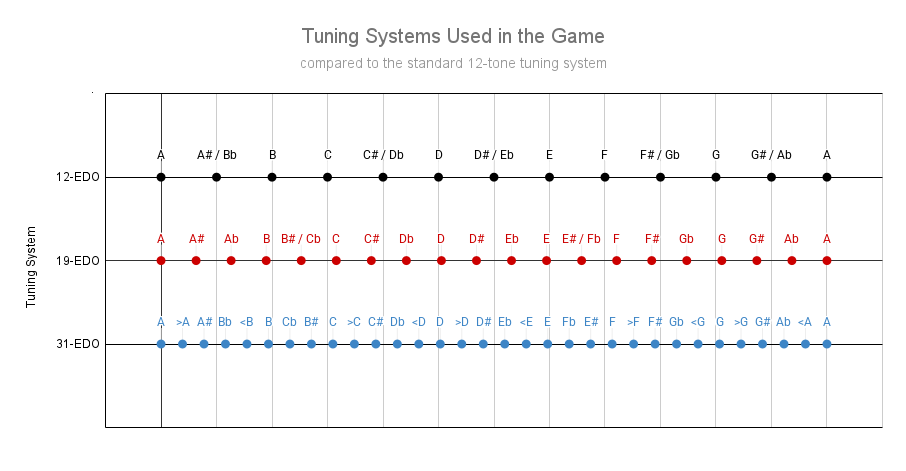
As stated above, I specifically went into the jam wanting to make microtonal music. For those who haven’t heard of or aren’t sure what microtonal music is, it’s music that has notes tuned between the standard 12-EDO system. It’s a broad category encompassing a lot of music from different cultures, and a lot of different ways of varying the tuning systems are possible.
So far, I’ve only experimented with EDO (Equal Divisions of the Octave) systems, where you take an octave and divide it equally into a certain number of notes.
I ended up using both a 19-tone tuning system (19-EDO) and a 31-tone tuning system (31-EDO). For the regular walking around music, I used 19-EDO, and for the title screen and credits music I used 31-EDO.
I wrote the walking around music first. For that one I mapped my midi keyboard to 12 notes that approximated 12-EDO and played around until I found a theme that I liked. Then for the second half of the track I repeated that theme but transposed it a third step down (an interesting property of 19-EDO is that its chromatic steps are third steps instead of 12-EDO’s half steps), which makes for a really interesting effect of the music almost melting rather than changing keys.
For the distorted version of the exploration music in the Distortion Realm section at the end (not the official name), I used a frequency shifter and slowly automated the shift amount to a lower and lower frequency, then at the end of the loop, I automated it to go up much faster to match back up with the loop point.
Frequency shifting is a weird, fun thing. But in essence, it takes all the notes of an audio clip and makes the lower notes shift pitch further than the higher notes. It’s such a wild effect to mess with.
Next, I wrote the credits music. This was the first 31-EDO track I wrote. I had just recently learned about the concept of neutral chords, and I really wanted to try it out.
In essence, the 31-EDO scale has two notes that roughly map onto minor and major thirds, and it has a note that lies exactly in between those two. That note in the middle of the minor and major thirds is called a neutral third (a fun side-fact is that if you go one note above the major, it becomes a supermajor, and same with minor, one note below becomes a subminor). As the name implies, it doesn’t quite sound major and it doesn’t quite sound minor, and it evokes subtly different emotions that are really interesting to me.
For this track I used the same melody from the exploration music, but I put it into a different chord progression (featuring a neutral chord at the start, which later resolves to the same chord but major) and a 3/4 time signature (instead of the exploration music’s 4/4 time signature). I went into making this track with the expectation that this would be title screen music, but my team gave the feedback that it would work better as credits music, and they were so right!
Then I wrote the actual title screen track. For that one, I went for a more melancholy version of the theme. I centered the track around a soft piano part. I took the same melody, time signature, and chord progression from the credits screen (with a modification, the neutral chord resolves to the same chord but minor instead of major for this one, to fit the melancholy vibe I was going for). I also went a bit slower for this one than the credits music.
In Conclusion
Okay, so I’m really happy with the work I’ve done for this jam. I pushed myself to do something I hadn’t much experience with. I stayed within the scope of what I could do in a single three-week period. While I’d love to keep working on music and sounds like this if we expand the game, I feel like I made everything I wanted to and the result was satisfying and a complete thematic and narrative package.I didn’t under scope, I don’t think I could have pulled more audio out of the three week period and have been as happy with it. Really, I’m so happy with the game we all on the team created. We all met together and used our individual skills to fulfill a creative vision we were all excited about. It’s something I really enjoyed making, I enjoy playing, and I hope you all enjoy it too.
Each member of the development team was kind enough to submit a reflection on their process, though we had to shorten them for length and clarity. Each of them can be read in full on itch.io: https://jergling.itch.io/uncle-henry-isnt-home