Fighting fascism through play
Developers and gamers finding ways to combat immigration injustice
by Jonah White
You don’t need me to tell you that things are bad. By the time you are reading this, “bad” probably refers to something completely different than it did a month ago. Right now, the bad I’m referring to is “Operation Metro Surge,” ICE’s assault on Minneapolis that started in December.
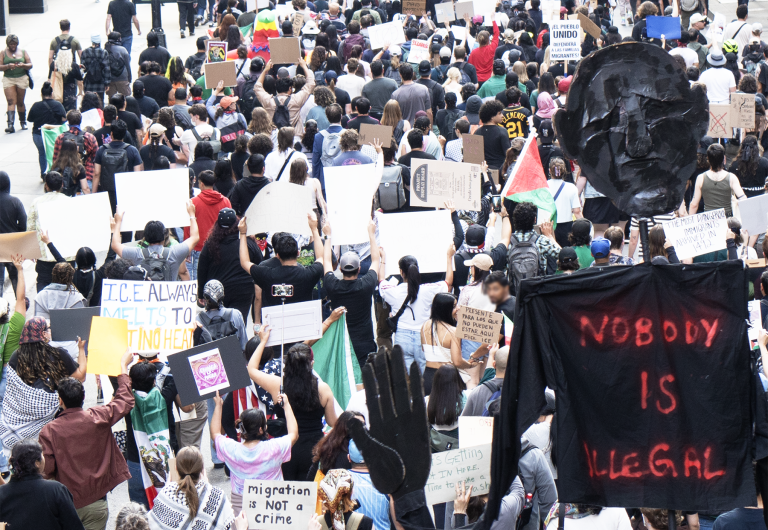
You know the stats. Two protesters executed in the middle of the street, at least six deaths in ICE custody out of public view, and thousands of people illegally arrested and thrown into detention centers. A majority of them innocent. Many of them U.S. citizens.
Things suck. You know that. If you’re like me, you probably feel pretty helpless.
My experience is that when I am not working a day job, I am running games, playing games, designing games, writing about games, thinking about games. Games are a major part of my life and community, and it can be hard to feel good about that when there is so much real horror happening in the world.
But in the midst of all this horror, I have found encouragement in how the communities I participate in have responded. Not content to sit back and shake their heads in dismay, many players have stepped up in the last few months to do what they can to fight against fascism and support our communities, and they have been doing it all through the thing they know how to do best: play.
How players are fighting ICE
For people outside of Minnesota, knowing how to help can be difficult. There is a human instinct to do something tangible in the face of adversity. While demonstrations and protests are helpful, they can only do so much for the immediate needs of the people affected by state violence. In these cases, the best thing that you can do as an individual is to support the people and organizations on the front lines monetarily.
Fortunately, gaming culture has developed quite a few tools for raising money for charitable causes over the past few decades. The following are just a few.
Charity streams
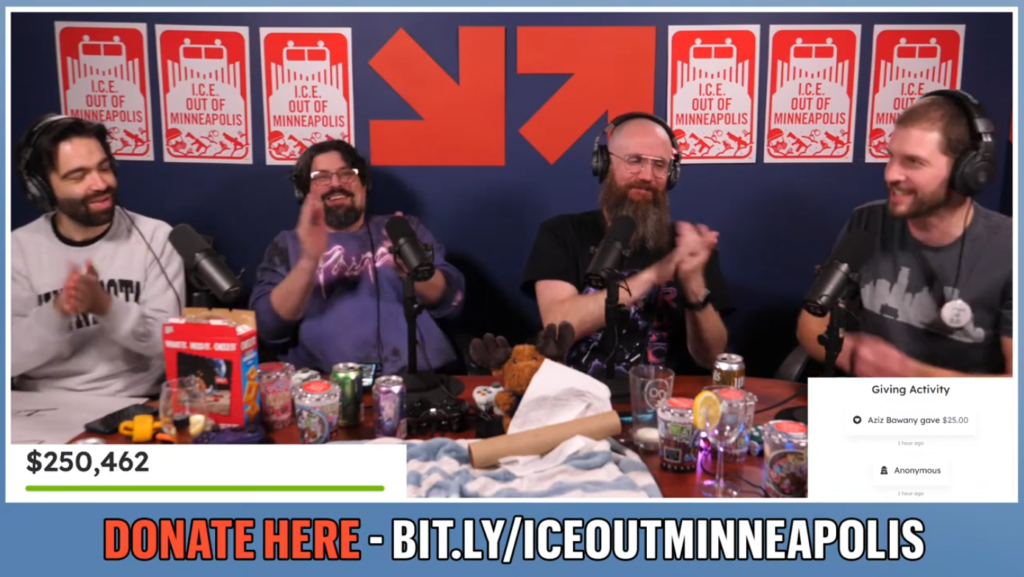
Twitch and YouTube have proven reliable tools in generating money for worthy causes. Games Done Quick is one high-profile example of the practice, but the beauty of these platforms is that anyone can set up a charity stream regardless of audience size.
For example, on Jan. 30, media outlets Giant Bomb and the Minnesota-based MinnMax teamed up for an eight-hour livestream that raised over $282,117 for Volunteers Enlisted to Assist People, ensuring that affected citizens have access to healthy food.
Meanwhile in Chicago, the Tabletop RPG community pitched in as well, with at least two charity streams giving their support to Minnesota. On Jan. 31, the Chicago Role Players’ Guild livestreamed a 24-hour actual play marathon of Daggerheart, the recent tabletop RPG from Darrington Press. The Guild raised $1,950 for the Immigrant Law Center of Minnesota and the North Side Housing Homeless Shelter.
Later, on Feb. 21, Dungeons & Dragons: The Twenty-Sided Tavern actor Diego F. Salinas invited friends and fellow cast members to stream a D&D one-shot. They raised $2,030 for the Refugee and Immigrant Center for Education and Legal Services, an organization that gives legal representation to immigrants across the country.
Just a handful of streams like these can ease the burden of communities affected by ICE and provide a fun and engaging way for communities to pool their resources for the good of others.
Charitable bundles
Game bundles are another popular method of fundraising in the gaming community, with possibly the best-known method being the itch.io bundle. Itch.io, a popular website for indie game designers to share their work, has allowed creators to bundle their works for years. An excellent way to provide discounts on bulk purchases, the feature eventually became an effective way to raise money for charitable causes.
The best-known example of a charitable itch.io bundle is likely the 2020 Bundle for Racial Justice and Equality, created in response to the murder of George Floyd, which offered over 1,700 games, tools, and assets from nearly 1,400 independent creators for a minimum of $10. The bundle eventually raised over $8 million for the NAACP Legal Defense and Educational Fund as well as the Community Bail Fund.
Since then, itch.io has played host to numerous charitable bundles supporting everything from trans rights to hospitals in Ukraine.
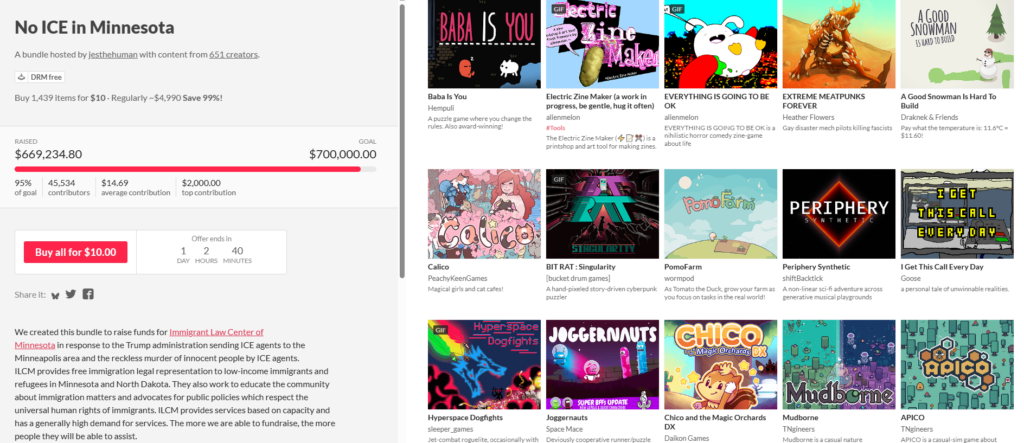
In February, itch.io began hosting the No ICE in Minnesota bundle, featuring 1,439 games from over 650 creators for a minimum of $10. At the time of writing, the bundle has made over $576,000 for the Immigrant Law Center of Minnesota, with plenty of time for that number to go even higher.
Fundraising events
In case you haven’t noticed by now, there are many ways to raise funds, and few of them require you to bear the burden alone. In fact, some fundraising can be done without a large commitment.
Take StartPlaying, a website that connects tabletop RPG players with professional game masters. They waived their regular platform fee for charitable games run in the month of February. Anyone who chose to could run a game and donate 100% of the profits to the Immigrant Rapid Response Fund. Simply by playing games, players and game masters were able to raise $25,000, with StartPlaying adding their own $3,000 to the fund.
Even small press designers are contributing in their own way. The team behind Coyote & Crow, the Native American-led sci-fi RPG, was crowdfunding their latest expansion while Operation Metro Surge was underway. Rather than take drastic action, they simply added a stretch goal to their existing campaign, promising to donate at least $1,000 to a Minnesota charity if the campaign reached a certain level of success.
Local action
The above examples were all about how the gaming community has supported Minnesota at this time, but Minneapolis was not the first city to be targeted by ICE, and it won’t be the last. Chicago saw its own brutal raids last year, and the threat of ICE returning is ever-present. While the need in Minnesota is immediate, there is value in supporting your local community, and there is no single area that needs support.
For a few more examples, near the end of February I attended Extra Life Chicago. The convention featured a little of everything: Street Fighter 6 and Mario Kart tournaments, Magic: The Gathering tutorials, miniature painting, passionate fan artists and small businesses exhibiting at booths, and local TTRPG group Rough Magic running D&D for curious players. The event raised $60,000 for Lurie Children’s Hospital of Chicago, supporting health care in the city.
In January, Level Eater Adventures ran their annual fundraising event for the Public Media Institute in Bridgeport. Seven tables played in a massive D&D game where the success of individual tables contributed to the overall success of the fictional town of Portsbridge and real-life money could be spent on in-game and out-of-game items to contribute to the fundraiser. All of the money raised went towards supporting local art and radio, giving citizens a way to make their voices heard.
A call to action
These are just a few examples of how people have supported Minnesota and their local communities in the fight against fascism.
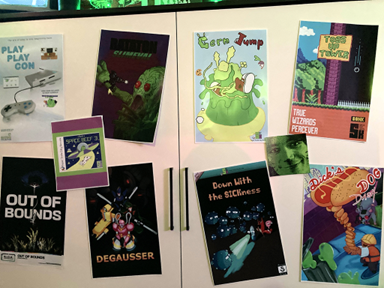
I am sure you know the usual advice for making your voice heard. Call your senators, join a protest, vote. But what I want to encourage you to do right now is spread the word! Don’t be silent. Talk with your neighbors, share opportunities to connect and be informed. When a fundraising event or charitable opportunity appears, share the news far and wide. Share it in a Discord, share it on social media, put a poster in your local coffee shop. The gaming community is large, it spans the globe, and there are pockets of community everywhere. It’s easy to overlook good news when it is buried in a barrage of terribleness, so it is doubly important that we keep each other informed.
We are not powerless. Our passions, our hobbies, are not merely an escape. We can do good when we leverage our strengths as a community to a better end.
My last piece of advice is to find a community where you can form connections and discuss the things happening in the world. Indie City Games is a great choice for in-person and online discussions. If you’re into tabletop games, check out the Chicago Tabletop Gaming Association, which hosts frequent meetup events and a Discord for players and GMs to connect and chat. There’s also Storygames Chicago’s Discord server, Save Point meetings at Is/Was Brewing, and countless local game stores and meetups you can join.
Stay safe, stay strong, and fuck fascism.