SICK Showcase Revives Forgotten Konsole
by Jonah white
This column originally ran in Back Alley Games Issue 15, May 2025
On a cool spring evening in April surrounded by the sound of laughter and shouted conversation, Sly McMahon Jr, his face wet with tears, watches a mechanical rat shoot a slime with a heavy rifle before rocketing across a bottomless chasm.
“I never thought I’d see this day,” he whispers to no one. The player pays him no mind, eyes glued to the refurbished CRT monitor in front of him. Next to the monitor rests a bright green dumpster the size of a breadbox, practically glowing in the dim light. The refurbished konsole hums softly as it runs a game long thought to be lost media: Rataton: Slimeval.
“I wish my father were around to see this,” McMahon Jr. said, wiping a tear from his eye. “All he ever wanted was for people to play his games.”
Sly McMahon Sr. was a programmer for the Super Indie City Konsole, commonly known as the SICK. After the konsole’s tragic failure, McMahon Sr. left the game industry in disappointment. He passed away in 2016 during a freak accident involving ketchup on a Chicago-style hot dog.
“I don’t think he realized,” McMahon Jr. continued. “Hell, I don’t think anybody realized how beloved this little konsole is.” As if in response, a crowd of people cheer as someone makes it to the top of the notoriously difficult platformer Toss Up Tower.
McMahon Jr. is just one of many attendees of the SICK showcase at Night City. Through the astounding restoration efforts of Indie City Games, the showcase was able to revive the long-forgotten video game konsole to delight players new and old, scoring a major victory for game preservation.
A SICK History
Developed in Chicago and released in 1994, the SICK was the most powerful machine on the market at the time of its release and boasted an impressive lineup of launch-day titles.
However, a series of unfortunate incidents led to many of these launch titles being delayed or outright canceled. This messy launch has become known as “the SICK kurse” by many and has inspired a number of conspiracy theories involving corporate sabotage.
A year after this rough start, Sony released the PlayStation to the world, quickly overshadowing the troubled indie konsole.
Despite these setbacks, the SICK has had a long and colorful life. According to game preservationist Dr. W. E. Tratt: “The SICK was popular among indie developers as far away as Japan. Not to mention the illegal speedrunning communities that grew around the konsole.”
When asked if there was any truth to the rumors that the CIA conducted psychological experiments using a relay of SICKs, Tratt stated that “all claims are unsubstantiated.”
In 2001, shortly after the discontinuation of the konsole, all known units were stolen from a Chicago pawn shop. According to police reports, no suspect was ever detained in relation to the robbery. SICKs have been nearly impossible to find since.
A Second Chance at Greatness
The SICK seemed destined to be a footnote in video game history, the subject of obscure blog posts and niche history books. However, the konsole has had a lasting impact on the imaginations of indie game designers.
Between its dumpster-like appearance and bright green color scheme, the SICK stood out from the shades of gray of contemporary systems. The games that made up its slim library also shared remarkable similarities in themes and designs.
This brand unity gave the SICK a unique personality, though this uniqueness may have been a contributing factor in the konsole’s lack of mainstream appeal.
The legacy of the SICK was so strong that over 20 years after its discontinuation, Indie City Games started a project to restore this piece of gaming history.
By searching old internet forums, scouring estate sales, and tracking down as many of the original developers as they could find, ICG was able to collect enough material to not only restore the original games, but reformat them to be played on modern machines. In the process, they uncovered more than a few konsoles thought to be lost forever.
“The real windfall was when we posted on itch.io,” one member of the restoration team, Muck Grimes, told reporters at the time of the event. “We figured somebody had to have some SICK material lying around, so we created a game jam to ask for any and all ephemera related to the konsole.”
The jam was a massive success. Dozens of contributors came out of the woodwork to donate vintage kartridges, posters, advertisements, and more.
“It was frankly overwhelming,” said Grimes, reaching for a nearby fire extinguisher. “By the end of it, we had so much material we knew that we had to have a showcase of some kind.”
When asked what the restoration process was like, Grimes said, “Let’s put it this way: we spent so much time asking ourselves how to emulate the SICK that we never stopped to ask if we should emulate the SICK.”
When pressed for further comment, Grimes politely declined in order to deal with a SICK that had caught fire.
The SICK-est of Showcases
On April 26, the showcase at Night City opened, and any idea that the SICK was a forgotten konsole were proven false. The venue was packed from the moment it opened to the minute folks had to be ushered out. Participants spilled out onto the sidewalk, sharing drinks and talking about their fondest SICK memories.
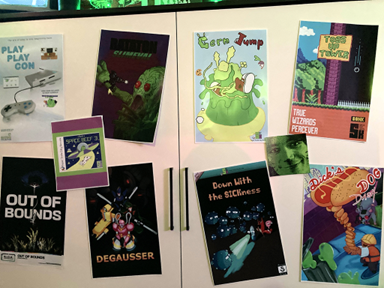
The interior of the venue was plastered with posters of games both featured at the showcase and lost to time, including the canceled JRPG Gomibako No Densetsu, Super Space Beef, and the mysterious Out of Bounds.
There were no fewer than three fully restored konsoles hooked up to CRT monitors, emulating the experience of playing the konsole in 1994. Two featured a reproduction of the original kontroller (sadly, no original copies have been found), while a third featured the optional SICK keyboard peripheral.
Each konsole was modified to play nearly a dozen games, most of them unfinished launch titles and demos long considered to be lost media.
The crown jewel of the event, with two dedicated stations on massive TVs, was Trash Dungeon. This action-packed twin-stick dungeon shooter was originally pitched as a SICK exclusive and was mostly finished before being quietly canceled.
After a rabies outbreak in Chicago, the development team behind Trash Dungeon, who remain a mystery to this day, feared that their game’s rabid raccoon protagonist was in poor taste.
Despite never being released, Trash Dungeon was notoriously caught up in the moral panic that gripped ‘90s America due to the game’s violence and opening instruction to “keep killing to stay alive.”
Former lawyer Jack Thompson is quoted as saying: “This game is an affront to human decency and should be thrown in the incinerator where it belongs,” while waving around a copy of Night Trap, a completely unrelated game by Digital Pictures.
Despite its unceremonious cancellation, Trash Dungeon went on to have a huge influence on the indie game scene, inspiring indie darlings such as The Binding of Isaac.
Dreck Swill, a programmer who worked on the original konsole had this to say about the event: “I didn’t think anybody remembered this thing. I am humbled but also, like, confused? Like, why? Why go through this much trouble?”
A Win for Game Preservation
While there are currently no plans to showcase the SICK at any future events, Indie City Games is in contact with several museums. So far, the biggest challenge has been in convincing these institutions that the SICK is a real konsole and not something that they just made up.
Video game preservation is vital to this industry, as it connects us to a shared history and teaches us how not to repeat the mistakes of the past. If there is one takeaway from the SICK showcase, it is that there is still very much a love and demand for these old games.
This was a real event that really happened, more or less as described here.