The State of Gaymes in 2025
An incomplete history of the prominence of queer artists in the games space
by Seb Galvez
This article originally ran in Back Alley Games Issue 16, June 2025
To be blunt about it, indie games are pretty fucking gay. However gay you think they are, make it gayer. Trust me.
Queer art has a tendency of finding its way into subculture and mediums off the beaten path, a side effect of creators often being pushed out of mainstream spaces and seeking both community and expression through less traditional means. It’s why queerness is so pronounced within punk and goth subcultures, zines, and comics.
So it is, of course, entirely natural that this would also go for indie games. Certain genres of game tend to be stereotyped as more traditionally queer. Visual novels are often frontrunners on this list, especially given their commonalities with NSFW games.
It’s undeniable that many queer artists have been highly influential in this space, for example: Christine Love’s Ladykiller in a Bind (2016). Aevee Bee and Max Schwartz’s We Know the Devil (2015) and Heaven Will be Mine (2018) may fly under the radar but have both heavily influenced the narrative games space.
Queer influence isn’t limited to the intimate, narrative side of things either. M.U.L.E., ostensibly the first turn-based multiplayer strategy video game, was published in 1983 and created by Danielle Bunten Berry, a trans woman. Coincidentally, she is noted by Sid Meier as a close friend and colleague of his; the first Civilization would launch eight years later in 1991.
Even if none of these are familiar to you, you’ve undoubtedly at least heard of Celeste (2018) and likely TowerFall (2013), both primarily credited to Maddy Thorson, a nonbinary developer. Celeste itself is often described as a coming out story by Thorson, with them describing it as a means of processing their own personal journey.
The presence of queerness in games as a subculture extends well beyond the development side as well. Competitive gaming in multiple spheres has long maintained a wide variety of transgender competitors.
Sasha Hostyn, aka Scarlett, was a prominent figure in the emergence of competitive Starcraft 2 play. Ricki Ortiz, aka hellokittyricki, entered the competitive fighting game community in the early 2000s and would maintain high tournament rankings until 2017.
It goes back as far as competitive gaming’s origins. In 1980, Rebecca Heineman, a trans woman, became the first national gaming champion when she secured her place at the top of a national Space Invaders championship. Heineman would also go on to contribute to lauded games such as Wasteland (inXile, 1988) and The Bard’s Tale (inXile, 1985).
As with all subcultures, it’s worth looking past the surface level of success. Outside of recent commercial successes such as In Stars and Time (insertdisc5, 2023), Signalis (rose-engine, 2022), or the ever-popular Monster Prom series (Beautiful Glitch), many queer devs continue to push the medium forward on sites such as itch.io.
There’s a good chance your favorite developer is heavy into the collective work of the anonymous DOMINO CLUB, the definitelynotbloodborne Nightmare Kart (LWMedia, 2024), or the plethora of narrative work being churned out by the DevTalk community.
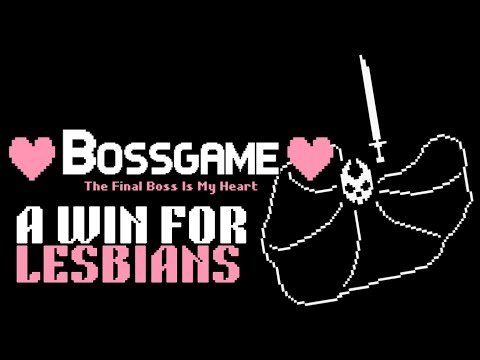
Personally, I’d recommend checking out Lily Valeen’s BOSSGAME: The Final Boss is My Heart (2022).
This is a very messy, non-exhaustive list of the history of queer people within games. There are plenty of people more qualified to speak on it with a deeper well of knowledge on the subject. I hope, however, that it’s enough to maybe make you consider the level at which queerness is wrapped up in something you care about deeply (I assume you care about it if you’re reading this).
Queer art has been at the forefront of every artistic medium, from painting and fiction to film and music; to care about a medium and its growth is to care about the well-being of the people within it. I’d encourage you to help make our shared space, medium, and industry somewhere that queer people can not only find tolerance, but support and care.
So, if you’re feeling up to it, maybe go play a really fucking gay game.