The weight of carrying both
Cartethyia and the queer experience
by ricardo lisboa
This article originally ran in Back Alley Games Issue 16, June 2025
This piece contains spoilers for the latest story update in Wuthering Waves.
Fiction has always been humanity’s most honest mirror, reflecting back the wars we wage within ourselves long before we have the capacity to understand them. When creators breathe life into characters, they are excavating something primal. That eternal struggle between the selves we are told to be and the selves we actually are.
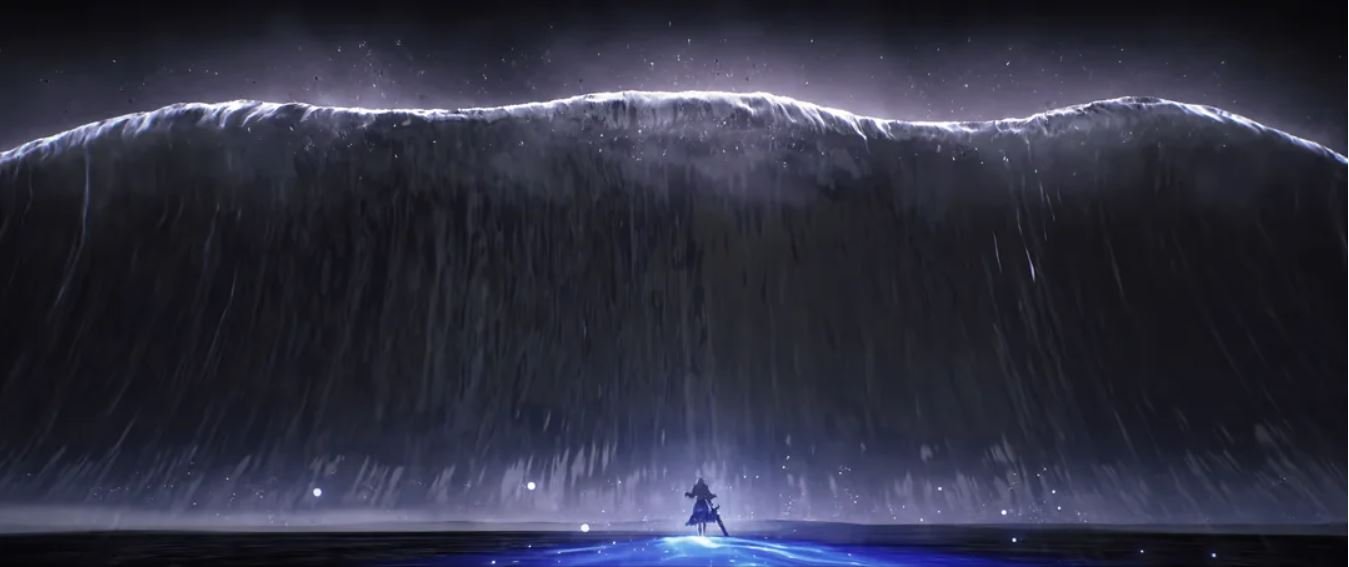
Following in this ancient tradition, Kuro Games’ latest character release, Cartethyia, the wandering knight of Wuthering Waves (2024), emerges as an avatar of our most fundamental conflict: the courage required to be ourselves and remain whole.
In the mythology of her universe, she is an impossibility. She is the Resonator of both the Sentinel Imperator, guardian of light and order; and the Threnodian Leviathan, harbinger of darkness. These forces are meant to be enemies, irreconcilable as oil and water. Yet within her, they coexist.
The Seeds of Contradiction
Her story resonated with me deeply. Growing up queer meant learning early that my very existence challenged categories. I become fluent in the language of opposition, discovering that the heart can hold simultaneous truths that seem mutually exclusive to everyone else.
Cartethyia embodies this reality with creative clarity. She doesn’t just represent the struggle between opposing forces; she shows us that integration is necessary and possible.
The game’s lore reveals that Cartethyia was “created by Leviathan—an entity designed to be ‘whole’ and ‘perfect.'” She was meant to be a vessel for darkness, a conduit for destruction.
Instead, she chose “to resist its will, turning away from the darkness she was born of, in order to aid the Sentinel Imperator instead.”
Most of us grow up being told we’re designed for one thing — heterosexuality, traditional gender roles, conventional life paths — only to discover our authentic selves demand something entirely different. Cartethyia embodies the experience of refusing to be what others created us to be, even when that resistance comes at enormous personal cost.
Beyond the Binary
In the oldest stories, the ones carved into stone and whispered through generations, there lived “creatures” who feel all-too-familiar now:
Grendel, deformed and denounced as the “descendant of Cain” in Beowulf’s blood-soaked halls, yet revealed to be the son of the king. Never simply evil, but the eternal outsider who could hear laughter he was forbidden to share in.
Medusa, maiden transformed into monstrosity for sins that were not her own, cursed to carry in her very gaze the weight of Athena’s divine injustice.
Frankenstein’s creation, sewn together from the discarded dead yet burning with a longing for love that his maker would never comprehend.
The stories painted them as monsters, but those who have lived on the margins know better. We recognize the ache of the uninvited, the fury of the perpetually other.
These ancient narratives immortalize what we cannot forget: that those who live outside the circle of belonging possess a particular kind of sight. They see the cracks in the foundation that insiders cannot perceive. They know intimately the violence involved in the maintenance of what others call order.
Cartethyia embodies the truth that integration is not about becoming palatable but about refusing the lie that we must choose between our light and our shadows to be worthy of love. When she declares that “the fight of good and evil is never ending,” she speaks with the wisdom of someone who has been asked to cleave themselves in half for the comfort of others.
In this life, she offers something more radical than acceptance: transformation. Not the transformation of ourselves to fit the world’s narrow definitions, but the transformation of the world through the fullness of our being.
The Blade That Heals
In the climax of her story, coming face-to-face with her shadow self and failing against it, she finds “not the bitterness of a defeat, but a deep, comforting gratitude.” There’s something profound about finding peace, not in spite of our contradictions, but because of them.
Cartethyia becomes a blade. Not a weapon of destruction but a tool that cuts through the illusion that we must be simple to be worthy of love. Her story suggests that our contradictions aren’t flaws to be fixed but sources of strength to be cultivated. That the very things that make us dangerous to rigid systems might be exactly what the world needs to heal.
This article was submitted by a member of the Back Alley Games community and was edited for publication by our staff. Opinions and thoughts expressed within are not those of Back Alley Games.