Interview: Party on Hallow Grove
by Seb Galvez
This article was originally published in Issue 8 of the ICG Zine, October 2024. It was reformatted in January 2026, but has not been edited further.
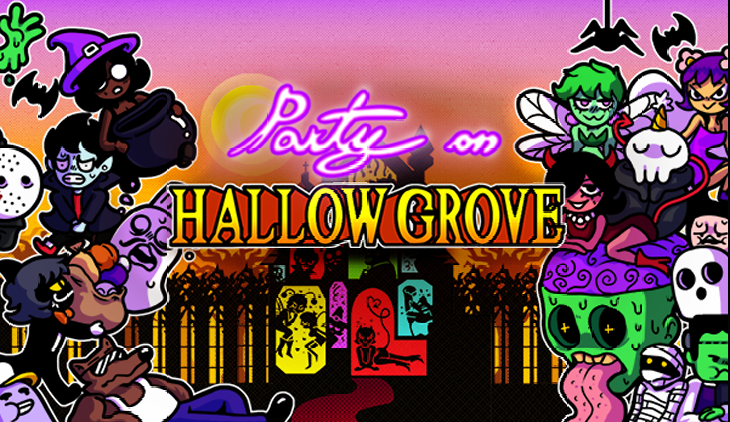
Party on Hallow Grove (PoHG) is a small, cute, Halloween adventure game where you are tasked with throwing Death the best surprise birthday party EVER! It’s a top-down RPG with an emphasis on story, exploration, interaction, dialogue and item trading. Talk to kooky guests, explore the mansion, trade party items, put up decorations, and play some party music – all before Death wakes up from his death nap.
On your quest, you will laugh, make weird friends, and learn to be kind to one another – and when the party is crashed by an unexpected guest, you’ll be faced with your biggest challenge yet.
Seb: Do you want to start by telling us a bit about what Party on Hallow Grove is?
Nattie: Yeah, sure. So, Hallow Grove is a small, cute Halloween adventure game where you are tasked with throwing the best surprise birthday party for Death, the Grim Reaper. It’s a little top-down RPG where you go around talking to the characters, trading items and just exploring the world. You explore this mansion collecting items, fulfill quests, and get to know characters as you progress through the story.
Seb: Sick. So, it’s a project that a lot of the local community has gotten to watch grow over the past year. Do you want to talk about its origins and how you got started on it?
Nattie: So honestly, the origin of Hallow Grove is that I just wanted to make a spooky cute Halloween game since I’d been trying to do game dev for a while but haven’t launched anything. I had a much larger project before that I felt kind of stuck with so Hallow Grove was kind of my way to just get off that and do something more fun, something I felt I could do right now.
I love Halloween, I love the fall season. It’s something that always brings me joy. I’m a huge fan of cartoons and animation in general, and I really like Over the Garden Wall, so I really wanted to make a game that elicits that feeling of “oh, it’s fall, I want to watch this.”
Seb: Were there any particular pitfalls or struggles you felt you ran into as someone who came from more of an art background going into dev?
Nattie: I guess I am more of a pixel artist and animator, but I have been using GameMaker for quite a while, over 10 years. So even though I have quite enough experience with it, it’s just something that for me is a harder discipline, so I think the hardest thing for me is organizing.
I feel people don’t talk enough about how much being organized really matters when you’re a programmer or doing any sort of design or coding. And so that’s really hard to do when you work a day job and you don’t have all the time, not all of your time can be used towards this game. So some of the hardest things for me were, oh, I had to work a lot these past couple of weeks, and then I kind of have to go back to the project and figure out, oh my god, what is this big chunk of code that I made when I was very tired and didn’t write enough comments, you know?
And as you make the game, you learn a lot more – I definitely grew a lot in my skills just by making this game, but it’s incremental. So the systems that I had built at the beginning of the game, the text box stuff or music system, later on in the game, it just kind of becomes, “Oh my god this is kind of shit to deal with right now,” or “I kind of wish I had done it this way,” or “this would have been so much easier.”
You realize things you wish you could go back and change to make things easier, but you just kind of have to run with it, or else you’d end up taking a longer time to make this game or just changing the system.
Seb: Yeah, even a small Trello board will go a crazy long way towards helping you just stay more structured, at least in my personal experience. What do you feel were marked differences in your experience between your previous projects and Hallow Grove?
Nattie: Honestly for this one, it’s just that I’m doing everything, you know, everything plus the music, which was something I wasn’t doing before. So, I feel being able to make the music for my own game really made it easier to stick to it. It’s a different art form, which is great for when I don’t want to make pixel art, or I don’t want to animate, or I don’t want to code today, you know, I can make music, and that motivates me to keep making the other stuff in the game, so it’s this positive feedback loop and keeps me from slowing down; keeping that snowball rolling.
Seb: That’s something I love about solo dev is just that ability to bounce between different disciplines, which if you’re a multimedia artist, it’s just such a blessing.
So, like you said before, you do come from an art background, which very much shows in the game – the art in Hallow Grove is a huge selling point. You have these very dynamic characters and animations and environments. Did your experience in street art play into that at all?
Nattie: Yeah, totally. My entire background in art is pretty much just when I was in high school. I got into pixel art, I wanted to make games, so I got into GameMaker; and then I wanted to go into animation and western cartoons. I love things like Adventure Time, Regular Show – those are still my biggest inspirations to this day. Just constantly playing games, watching cartoons, watching movies, all those things inspire me.
Then I went to school for animation. I also did street art a bit when I was in college. But it was mostly just something I did for fun. I met a few friends that did it and they kind of dragged me into it, but I really enjoyed it. I did stickers with my face with fricking eyeballs popping out, that kind of very stylized thing. And it was really fun, you know?
When I started doing street art, it was very bare bones. I bought this crappy sticker paper at an art shop and tried to make stickers with it. But then I was like, oh wait, you can print stickers. I had a friend that hooked me up at the printing station at my school and I just started putting them up and it was fun while it lasted.
Seb: The emphasis on character art really shows particularly in the dialogue portraits, they’re all incredibly expressive and the sprites convey a lot even with just a few frames of animation, so both of those backgrounds, I think, really get to shine in this chosen medium. What stories influenced this outside of Over the Garden Wall? Are there any other particular non-game influences that went into this?
Nattie: For me, art and game-making are very therapeutic, so I wanted to make a game that helped me feel better I was just spit balling ideas, like “Oh, what if it was about a Halloween party, I’d love to make a Halloween party.” I haven’t been celebrating Halloween lately, I haven’t gone to a friend’s house or dressed up, all that stuff. So, stuff like “I feel kind of lonely,” or “I feel like I’m poor as fuck,” you know?
So, a lot of Hallow Grove was this therapeutic way of imagining a better life and imagining things I want to see in my life.
Seb: Is one of those things giant sentient evil trees with malicious intent?
Nattie: I view creativity as something that has a life of its own. So I remember the whole idea for Frankie being a jock just came from when I was first making doodles in my sketchbook and I was feeling low energy and wanted to draw, so I just started drawing really tiny drawings in my sketchbook to motivate myself and one thing I ended up drawing was just this small picture of Frankenstein wearing a bomber jacket and I was like hmm, I just thought it looked cool and I gave him a little pube stache, and I just kept going with him being a jock. And that kind of stuff just comes out of you when you’re in the flow, in the moment.
So, a lot of that stuff came out of those moments: the tree, Frankie, the cat, all that stuff. Just kind of asking “what is Hallow Grove to me?” You’re interacting with it as if it were a real thing that is happening somewhere else, you know? And you’re just kind of channeling it. It’s a lot of how I like to do art.
Seb: It’s a very intuitive sense of design. I think that as much as we want to attribute our good ideas to these extensive plans and long, thought-out processes, half the time our best stuff really does just come from winging it and letting our brains go into a passive, in-the-flow process.
Nattie: Yeah no, totally. I feel like when I’ve tried to plan something, I feel like that’s when stuff doesn’t go that well for me. Like when you’re forcing it, it’s just trying too hard, you know? Which isn’t to say that I didn’t try or didn’t put effort into this game or this art or this project or anything. It’s like you said, it’s an intuitive thing. It’s learning to trust your energy.
Seb: Yeah, it’s just letting yourself ride on your own tendencies. I think some of the best stuff I’ve personally made or been the most satisfied with has been projects where I’ve been like “no, that’s cringe” and then being like “no, I should actually go with that and make the thing that I think is cringe because it’s probably better.”
Nattie: Yeah, yeah. And one thing I really want to tell other developers with this game is exactly that, you know, trust yourself, go with the flow, go with your gut. That’s what helped me not just make, but finish this game, you know?
We always talk about scope creep and stuff like that. And I don’t know, that was another thing about making this game that was sort of an experiment, like a new way for me to approach making a game. Whenever that came up, that sort of tendency to plan something and say “Oh, I need to put this in the game because this would be sick, this sells” or whatever, it’s just kind of taking a step back and asking “well, does the game really need that, is that really part of the game, the core idea? Is that easy for me to do right now? Do I even want to do that right now?” Stuff like that.
Seb: Yeah. It’s definitely a good example of building around a single core concept that’s been built out just constantly. It’s sort of in ever expanding rings. You just take that core idea and keep building on top of it instead of branching it outwards. The result is definitely something that feels like someone suggested “what if Halloweentown threw an absolute rager?”
How do you feel this has affected your idea of where you want to take dev going forward?
Nattie: Ah, that’s tough because honestly, I don’t know yet. I’m constantly thinking about that right now, especially since it’s nearing release and it’s almost over. I don’t know.
A lot of thoughts have been, do I want to make another big game, or do I want to make a bunch of small games? Do I want to just take a complete break? What I can say is that it helped me realize what really works for me. Especially when it comes to things like scope creep, my own creativity, having fun while developing. People have told me “oh, it’s cool that your characters swear a lot” you know, I think that’s really fun and that’s one thing that helped me write the game.
Whenever I tried to write without any swearing, it just didn’t happen, it was harder, I couldn’t come up with ideas, the characters didn’t feel like they were real people talking, and approaching it that way helped me find my voice.
Seb: Entirely, despite the fact that games have been around as a medium long enough that, you have people who are in middle age or older who have been playing games since home consoles or were first to things since PC gaming’s inception, but the medium hasn’t really allowed itself to mature with its audience. And when it comes to them not shying away from more adult themes, language helps with that.
Like currently, I’m working on a project that touches a lot on my hometown, and I found it incredibly hard to write convincing characters who don’t swear like sailors.
Nattie: Yeah, exactly. I think if there is anything that I did take from this project about how I want to go about dev moving forward is just keep making games this way; keep that snowball rolling of creativity and experimenting, keep having fun.
Seb: It’s really cool that you found a process that works for you. I know you mentioned that you intend to play a bunch of games. Is there anything on that list that’s a particular standout at the moment?
Nattie: Ooh yeah, so I got a PS2 because there was a pawn shop near my place that was selling one, and I got my hands on some games. So, I’m currently playing Ratchet and Clank. I also got a copy of Dark Cloud, which I’m very excited to play. I’m gonna pour hours into that, I’m ready to no longer be a human being.
Seb: Does this mean we can expect a Hallow Grove 3D platformer in the future?
Nattie: Oh my god, that’d be amazing. That’d be insane. But yeah, those PS2 games, I feel like they’re something else. Everyone here at Indie City Games has so many good recommendations. I just kind of want to revisit them.
Seb: Yeah, you’re definitely not going to be wanting for any lack of PSX games if you’re looking for those given that we’re kind of having a renaissance right now.
What would your go-to Halloween party snack of choice be?
Nattie: Oh, this is a tough question. Um, honestly, if I’m thinking of snack of choice, I just think of candy, reaching into a bowl and grabbing from those bags you buy at like Walgreens that has four different candy bars in it. It’s got a bunch of them. Just grabbing into one of those, grabbing a Butterfinger, the Reese’s, oh my god, the fucking jack-o-lantern shaped ones. They taste better, they 100 percent do, I don’t know what it is, but they’re crack. Also, I really love me some Twix.