Detective Instinct: Farewell, My Beloved
A true, flawed send-up to the DS era of visual novels
by Seb Galvez
Developer: Armonica LLC
Release date: Nov. 26, 2025
Platform: PC
It’s not uncommon to see “nostalgia” or “retro influence” used to handwave lackluster graphics in indies. PS1 has been well-trod as a reference point for low-poly games with muddy textures, completely ignoring the intensely beautiful and detail-oriented work of real games for the system, such as Breath of Fire IV.
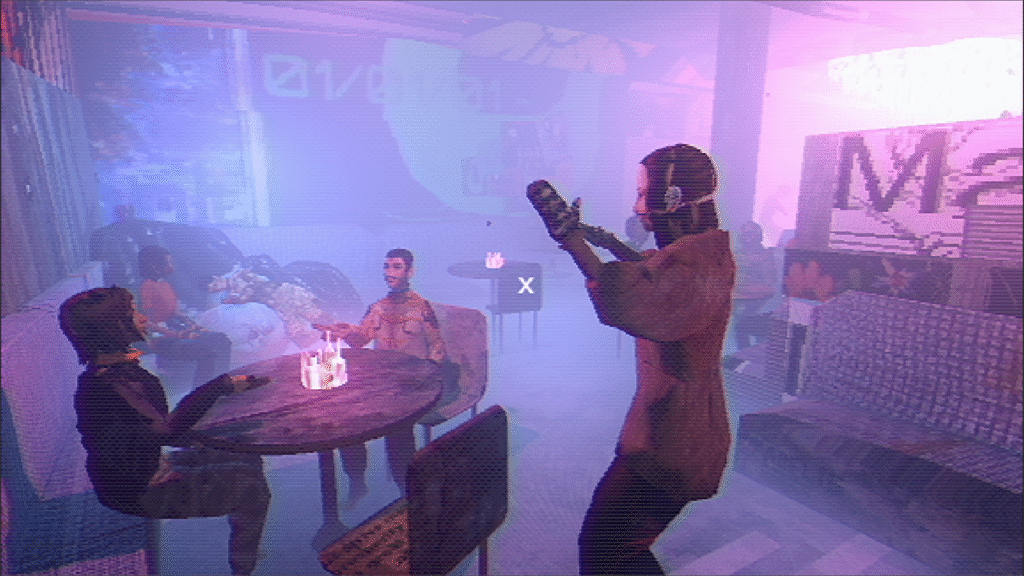
By contrast, it is the Nintendo DS’ influence is felt on all levels in Detective Instinct: Farewell, My Beloved, from the carefully pre-rendered and blurred 3D backgrounds to the larger than average text size – something that is worth praising in itself. Too many story-based games out there have font sizes that require the player to squint at a monitor, let alone a TV.
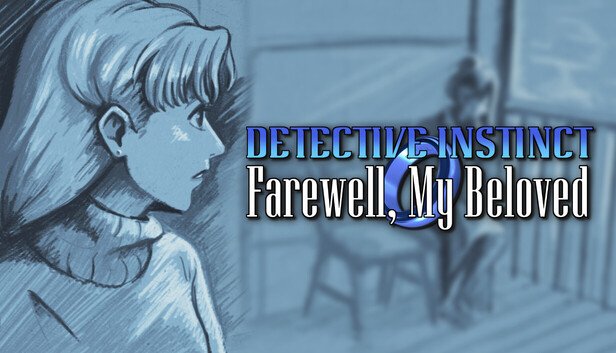
The sketchy pencil strokes in the game’s flashbacks and luxurious title card are a bit too on the nose to not be an homage to Hotel Dusk: Room 15, maybe the most lauded mystery game on the DS, and the train setting bears more than passing resemblance to the 1997 PC adventure game The Last Express. It is in every way a love letter to the Nintendo DS, point-and-click adventures, and classic TV detectives. It is a game that grounds itself in nostalgia, both for better and worse.
Detective Instinct opens immediately on a murder, after which our player surrogate is shortly implicated during a hotel stay in definitely-not-West Berlin. The murder victim in question turns out to be an immigrant (from definitely-not-East Berlin), introducing the theme of how arbitrary borders shape human lives, a constant presence in the rest of the game. It’s a shame that in a game with such strong police presence, the story fails to fully commit to making any political statement, often coming close before reverting to maintain the status quo.
Some players might bemoan the lack of more eccentric characters like those of the Ace Attorney series, but this would be a disservice to what Detective Instinct actually is: an episode of an 80s procedural mystery show in which America’s nosiest and most oblivious pair of college students disrupt an otherwise quiet train. It is in the same vein as any episode of “Columbo” or “Murder She Wrote,” albeit with less memorable protagonists than J.B Fletcher or the titular detective.
This isn’t to say that the game’s characters are without merit. There are more than a few charming interactions with its cast of potential suspects, with my personal favorite being two errant golfers.
The problem is that the game seems to oscillate too much between the urge to be a serious, politically charged mystery and the comfortable territory of a simple, lighthearted romp through a beat-by-beat procedural.
Perhaps what stands out most in Detective Instinct, apart from the absolutely stunning visuals, is the more ephemeral parts of its structure. Things that would feel out of place in a modern game’s quality of life but are true to the quirks and clunks of the system Detective Instinct seeks to evoke. The way menus are navigated, at times obtuse and others overly simple, places an emphasis on nostalgia of not just content, but form. It is in this particular area that Detective Instinct succeeds and truly stands out.

Despite many games making a claim to evoke nostalgia, the uniform layout of modern controls inevitably seeps its way into them. By contrast, in Detective Instinct, you begin to feel the controls as if you were playing them on the Nintendo DS (a now over twenty-year-old system, for those keeping count). Even on a keyboard, it becomes easy to envision the navigation being done with a small D-pad and two buttons, with the game’s notepad relegated to the lower screen.
The menus, though true to the era, are clunky. Dialogue options will send you back to a root menu, forcing you to click through multiple times, and direction for where to go next can be confusing. Choices don’t shape direction, with any deduction on the player’s part being a matter of course in the story. More than once I found myself rotating through options, attempting to find the unspecified choice the game wanted me to make in order to progress to the next scene.
Detective Instinct’s greatest flaw is that it never seems to fully trust the player, forcing you through multiple reviews of simplistic information and choices that have no real fail state or alternative story outcome. As a mystery game, the player is never truly asked to solve anything. The result is more that of a kinetic novel with additional menus rather than any true mystery where the player pieces together evidence, makes deductions, or performs risky accusations.
My criticisms here shouldn’t be mistaken for lack of fun. I genuinely enjoyed my time with the game, finding myself settling into an easy flow. It gave me nostalgia for a game I’ve never played. Detective Instinct is not a new Ace Attorney, and that’s okay. It doesn’t need to be. It is something entirely different but equally important to our shared experiences in the medium.
It’s a piece of art less interested in chasing the immediate imagery of mainline series installments instead choosing to replicate the rough edges of a platform and the design tendencies that make up the character of a specific era of game development. Detective Instinct is that one game you played in the backseat of a car on a long trip, or under the covers at night when you should be sleeping.
It’s well worth your time, especially if you’ve ever pulled a random game off the shelf on a whim and ended up with an experience that stuck with you, rough edges and all. It’s the game that you assume is a ubiquitous experience for everyone who played the platform, only to find out it wasn’t.

Detective Instinct: Farewell, My Beloved: 7.7
Clunky yet faithful to its DS-era inspirations, Detective Instinct: Farewell, My Beloved is full of beautiful tableaus and charming characters yet falls flat when it comes to player choice and menu design.