A Scottish studio makes the most American games
Rockstar Studios’ influences and how they’ve captured American culture
by Jesse Boruff
When I think of Rockstar Games, I think of movies.
Not because every one of their games has an actual film counterpart. They’re just cinematic. Take the first Grand Theft Auto, with its caricatures of American criminal types and its scenes bathed in moody light. That game was incredibly effective at placing you in its intended setting, the grungy, Ameri-punk art style and hyperbolic – even stereotypical – depictions of its characters adding to the sense of darkness the game carries.
The game is as memorable as it is because it, and say it with me: makes you feel like a criminal.
It’s always great when games achieve their goals, but the truth in these games is more impressive when you consider who, exactly, Rockstar Games are. When discussing the studio that’s known for the Grand Theft Auto and Red Dead Redemption series, I’ve run across the assumption that this is an American studio riffing on themselves. That assumption collapses, however, under a bit of scrutiny. Ever wonder why the doors on bathrooms in GTA’s virtual nightclubs might say “WC” on them? That’s because Sam and Dan Houser, Rockstar’s founders and GTA’s directors, are Scottish. As such, English humor is all over their games: The hilariously-named internet cafes called “tw@,” self-help gurus on the radio that simultaneously insult you and beg for your money, and absurd missions met with a deadpan style of humor most popular with those across the pond, just delivered in American accents.
A lot of the stranger missions of Grand Theft Auto V have dialogue that reminds me of a Monty Python sketch; absurd, surreal and deadpan. Despite those foreign roots, I don’t think it would be fair to say that GTA is an outsider perspective on American life these days, what with the studios being headquartered in New York City. However, I would argue that the foreign sensibilities the studio brings to the table are necessary for the feeling of true Americana that their games are able to produce.
It’s because of their love of the culture and their distant reverence for American media that the games are as funny as they are. The Housers admit to taking in hefty amounts of American cultural exports in their younger years, something that’s very apparent after looking at their work. The games the pair have produced balance the culture worship of a foreigner with the kind of clowning that is only possible by people not beholden to that culture.
Gangsters
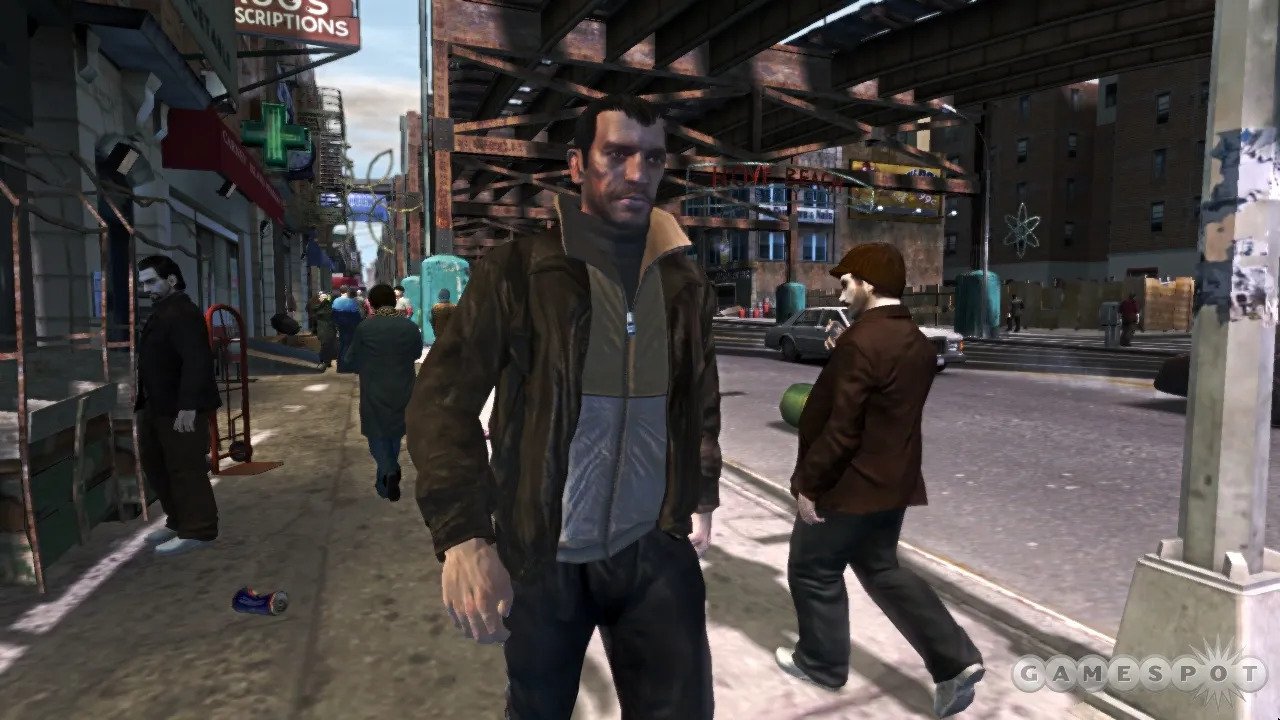
Rockstar’s greatest trait as a studio has always been their ability to create worlds that felt organic and lived in, and in the case of their GTA series, that means hyper-real American cities chock full of the same kinds of people that inhabit those spaces in real life. Grand Theft Auto: San Andreas is a Shakespearean tragedy wrapped up in the clothes of Los Angeles gangster movies like Belly. Grand Theft Auto IV’s Niko Bellic is a Balkan refugee attempting to make it in America while finding out it’s not all it’s cracked up to be. Sadly, he’s fled one war zone just to end up in another. The message of Bellic’s story is that you can’t run from your past. It will always end up chasing you. The next entry in the series, Grand Theft Auto V, also featured a cast being chased by their pasts, however, the narrative does allow for a more optimistic ending if the player is willing to work for it.
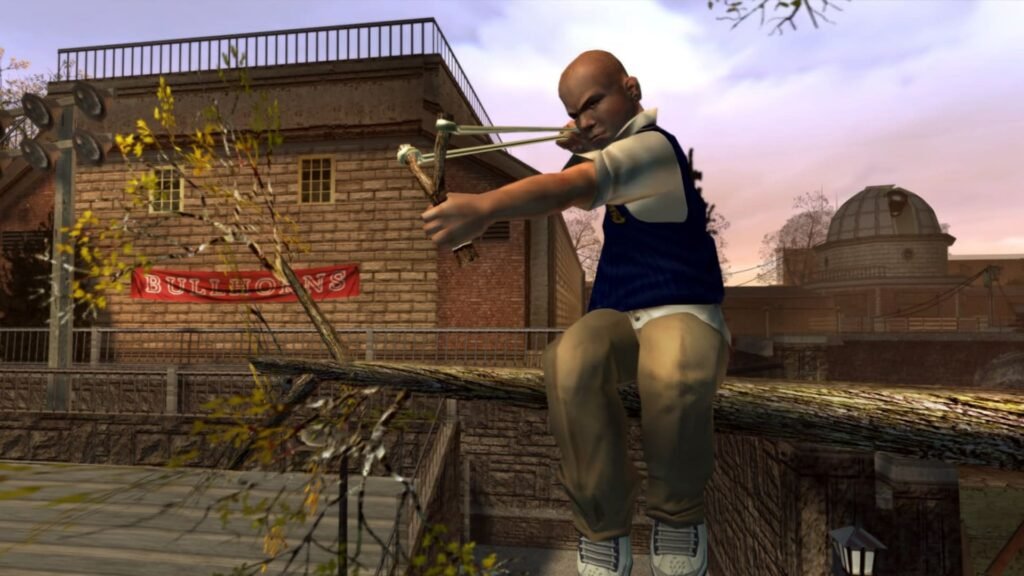
For slightly younger audiences, there’s Bully, where young Jimmy must decide both his social and academic fates after being abandoned by his awful parents at a boarding school. Like the GTA games, the self-aware political commentary is delivered with a tongue firmly held in a cheek. However, as these games move from fad to phenomenon, it becomes important to consider how they’ve gone from being inspired by American culture to creating changes in it.
When doing the preliminary work on a new title, the team at Rockstar often goes to the real-world locations they’re basing their game worlds on, not only to see the sights, but to learn local history, culture, and lingo. With titles like San Andreas that depict West Coast hip-hop and LA gang culture, the team went to Compton and South Central and interviewed those who lived there. On the other hand, Grand Theft Auto IV feels like a snapshot of New York City and the cynicism that started encasing the fading idea of the American dream in a post 9/11 world.
Rockstar have taken the mythological American gangsters, villains and heroes of iconic movies like Reservoir Dogs, and held a microscope up to them, imagining what their worlds would be like if people cared to look deeper. I can only imagine how someone in the year 2150 would experience the world of Grand Theft Auto IV, and how they might glean more about the reality of the early 2000s from a game than a textbook.
Hell, it was San Andreas that first exposed me to West Coast hip-hop, which I’m a huge fan of. Even the games’ car radios are, besides being the vehicle for talk show gags and tongue-in-cheek references, essentially a curated museum of music. I wouldn’t have loved the Doobie Brothers or Jane Child as much as I do now without the radio in Grand Theft Auto V, so I imagine as time goes on, our hypothetical person in 2150 stands to gain even more than me in that department.
I’ve argued that Rockstar have positioned themselves as some of the most prolific archivists of American life and culture outside of the academic world. In doing so, they’ve also created some of the most compelling narratives of all time. For all the discussions of preservation and parody, the thing that makes these games so special is their ability to make one feel like a participant in their worlds.
Cowboys
The Red Dead Redemption series is less parodic than its urban sibling and acts as more of a love letter to America’s other great mythological period, the Wild West. The actual condition of the time is felt in everything from the dialogue to the gameplay, once again preserving the state of America through the lenses of their games. The Red Dead Redemption series gives us the dying West; names beginning to fade into legend as the Wild West was tamed and industrialization swallowed up the frontier. Red Dead Revolver is a special case, as it was not originally a Rockstar game, though it would pave the way for Red Dead Redemption 1 and 2’s depictions of 1901. The stories of John and Arthur don’t just give us an accurate depiction of the taming of the West but also feature some of the deepest character studies brought to the Western genre, up there with movies like Unforgiven. You can trace eras of American culture via these games, the sensibilities and prevailing opinions of the time becoming a looking glass into the past.
It is only stories with the kind of truth that Rockstar is able to produce that are able to create strong responses in audiences, and I am no exception. In 2018, Red Dead Redemption 2 saved me.
I felt detached from a lot of people, from a lot of things I liked. My future felt the most uncertain it ever had. In an attempt to reconnect with myself, I retreated into gaming just as Red Dead Redemption 2 was released. An avid fan of the first game and Westerns in general, it was a no-brainer, day one purchase for me, as it was for most. And just like most others, the ending completely obliterated me. It changed my life.
I distinctly recall having a handful of my best friends over. I’d just finished the game and was visibly a bit shaken. When I was asked how I liked the ending, I started to cry. Weeping through my explanation of why the ending was perfect, I distinctly remember saying through wracking sobs, “no matter who you are or what you’ve done, you can still seek redemption.” Ever since then, it’s stood in my eyes as the epitome of gaming narratives. In fact, it stands among some of the greatest Westerns of all time when it comes to depicting the Old West. The greatest advantage Red Dead Redemption 2 has over something like Tombstone, though, is that I played it. I was Arthur Morgan, I slept under the stars and hunted deer for my camp, I held up trains and did what I had to do for cash. The game felt intimate in a way impossible for film to match.
That’s evidence, in my eyes, that Rockstar has cemented their legacy in American culture. Their games have surpassed many others, becoming a mirror that players hold up to their culture. Those players wait with bated breath not just for the hyper-realistic graphics, or brand-new guns, or unique mechanics, but to see what the team has to say about the current moment. How does Grand Theft Auto: Vice City look in 2026? What about contemporary culture will they lampoon and what will they celebrate?
For a Scottish Studio founded by two brothers, I’d venture to say that’s a hell of an achievement.
Gangster and cowboy movies
When I think of Rockstar Games, I think of movies. Not because they’re imitations, but because they’ve achieved the same cultural permanence. Like the great gangster movies, Westerns and crime dramas that inspire the worlds of Rockstar’s games, the games themselves have become cultural landmarks. They create an authentic snapshot of people, places, feelings, dreams and eras with a wry, sentimental truth that few can match. It’s what makes their worlds feel so compelling.
When I bring up the topic of film, of movies like Belly or Tombstone, films that achieve similar tones to the GTA and Red Dead Redemption series, I do so out of admiration. The medium of gaming is young, still. Films have decades of development that games haven’t, yet the way the lads at Rockstar craft their games makes me think that the medium is growing at an exponentially faster rate than once thought.
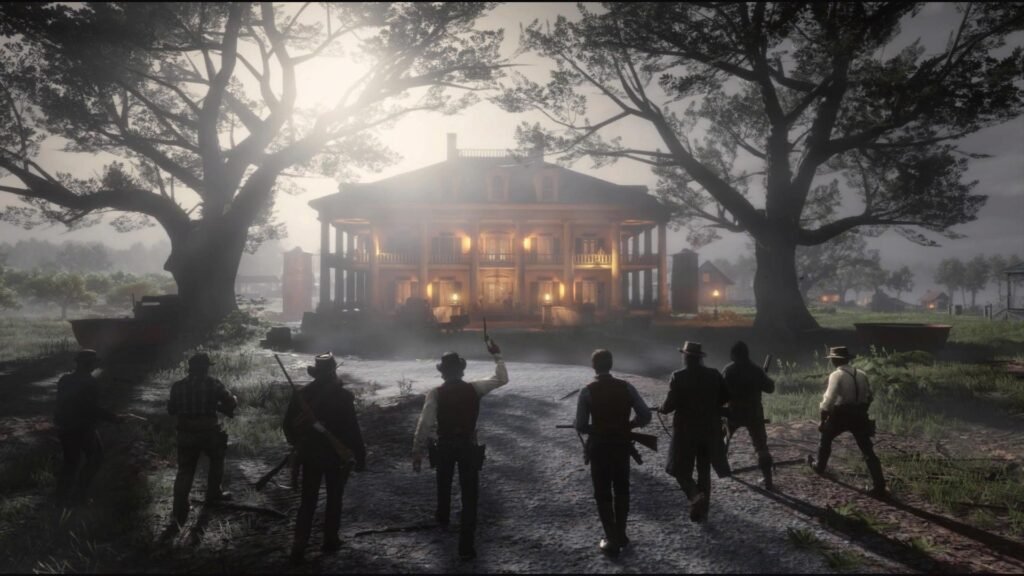
To borrow some terms from film studies, there are plenty of cinematic tools used in Rockstar’s games that would be at home in any Oscar darling. My mind instantly goes to the siege on Braithwaite Manor in Red Dead Redemption 2, as the camera pulls behind the gang as they line up. It gives you one of the most iconic shots in gaming – I’d even venture to say in Westerns, period. Beyond large titles like Red Dead Redemption 2, you get moments like the end of Bully, where a schoolyard grudge is turned into a dramatic and cinematic climax atop the school’s clock tower during a heavy thunderstorm.
These moments are similar to those found in film, but films simply show us a story, whereas games allow us to live a story. That is the power of great studios like Rockstar.
At time of writing, Grand Theft Auto VI is on the horizon and its presence is felt even months away from release – publishers are actively shifting their own game’s release dates so as not to coincide with GTA. Every trailer is dissected obsessively. Every leak is scrutinized. Entire online communities have spent years mapping GTA VI’s iteration of Vice City out without setting foot in it. It’s an entire cultural event and the game isn’t even out yet.
Perhaps that’s the lesson here. Some of the best American stories are told by those far enough from America to see it clearly. Through the satire, criticism, and even reverence, Rockstar has spent a majority of their existence as a studio faithfully documenting American culture. In so doing, this Scottish studio has created some of the most American games ever made.