I’m glad Sufjan Stevens’ 50 State Project failed
Finding Midwestern beauty through two indie folk albums
by amelia Zollner
In the 2000s, not-so-indie folk artist Sufjan Stevens told the greatest lie of his life. After making albums about Michigan and Illinois, he vowed to turn the other 48 states into albums in a press release. Quite a few fans grew excited, but it was never a real plan to begin with.
“I have no qualms about admitting it was a promotional gimmick,” he said in a 2009 interview with The Guardian.
Although Stevens quickly abandoned his faux 50 state project, his music remains tied to locations, even if the state of origin isn’t clearly denoted in the name. He traipses through distant family memories in Oregon on his well-known album Carrie & Lowell. One of his lesser-known works, The BQE, explores the Brooklyn-Queens Expressway. He even floats away from Earth to explore the solar system on Planetarium.
Of course, people who lived in states outside Michigan and Illinois were disappointed. According to a report by The Ringer, even Stevens’ backing band tried to influence the state he’d pick next. NPR itself coerced Stevens to write a podcast-exclusive song about an elusive bird in Arkansas. And, in 2020, 200 musicians teamed up to make 510 imaginary Sufjan songs, with an album for every state.
The allure of having an album about your home state is obvious, and I understand why fans are eager to beg Stevens to step beyond the Midwest. But really, it would be too easy to make albums called California or New York. Michigan and Illinois are special because they’re able to unearth meaning from the mundane, and I am eternally glad that Stevens never went beyond the Midwest with these albums because they’ve made the Midwest special to me.
Illinois
I grew up in a pretty unremarkable suburb of Chicago, and I was very bored there. The Chicago suburbs are designed for cars. In most of them, you can’t really walk anywhere unless you’re lucky enough to have a friend on your block. If you decide to attempt to be outdoorsy and go on a hike in a forest preserve, it’s usually marred by the buzz of nearby highways, unsightly manmade lakes that just don’t look real, and a lack of wildlife. But even if you’re a teenager with a car, meaningful, accessible third spaces are few and far between. My friends and I mostly either hung out in someone’s garage, went on aimless walks, or took the train to Chicago. So, I really, really wanted to get the hell out of the Midwest.
When I discovered Stevens in 2018, I was deep in the depths of suburban yearning. A lot of it was heightened by the fact that the Midwest is also rarely depicted in media outside of the weird dichotomy of Ferris Bueller’s Day Off-style Chicago fantasies and those Field of Dreams-esque movies that mystify cornfields, so I was very puzzled to hear an album that seems to holistically revere Illinois, suburbs and all.
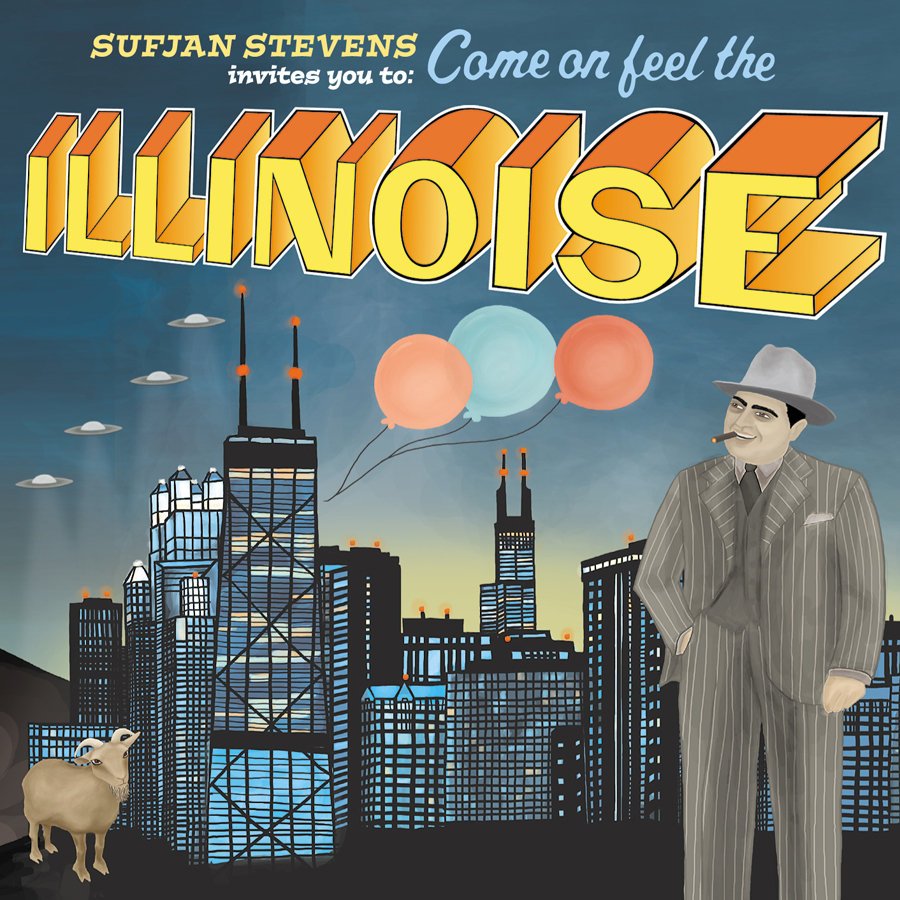
Illinois, for all intents and purposes, is a theater kid-ass album. It’s grandiose, it’s personal, it’s a little bit cheesy. Most people know it from “Chicago,” the album’s catchy anthem about the hope of being young and rediscovering yourself in a big city. I loved “Chicago” at first! But “Chicago,” actually, is now my least favorite song on Illinois. That’s because Stevens is at his best when he’s peeking into little-known corners of the state. He’s at his best when he recalls familial nicknames in Decatur, when he sympathizes with its serial killers and ghost towns, and when he name-drops random suburbs that have probably never been name-dropped in songs before.
My favorite song on Illinois, and the one that almost every fan will tell you is the best, is “The Predatory Wasp of the Palisades Is Out to Get Us!” It’s a beautiful track that equates the shame of Stevens’ queer awakening at a Christian summer camp to the pain of being stung by a wasp, but one weird thing that I really admire about it is how Stevens links the geography of Illinois (specifically the Mississippi Palisades) to this pivotal memory.
As the song builds up, it alternates:
“We were in love, we were in love / Palisades! Palisades! / I can wait, I can wait”
It’s like Illinois and its landmarks are just as important to Stevens as his first relationship, like the memory of the prairies beneath the Palisades is the glue that holds this memory in his mind. Illinois as a whole was so important to Stevens, in fact, that it got a second album of outtakes titled The Avalanche, which gets even more geographically niche with references to Pittsfield and the Kaskaskia River and an outbreak of tornadoes that tore through a distant suburb.
The way that Stevens reveres unknown locations on Illinois the album made Illinois the state interesting to me — if Stevens could find meaning in these random-ass suburbs and landmarks and historical figures, maybe I could too! And I have, for the most part.
Michigan
I have a lot less to say about Michigan the album because I did not grow up in Michigan the state. Stevens’ first state album, Michigan, offers bleaker vignettes that peek into the state’s forgotten corners. It’s kind of a weird album — there’s not really an anthemic centerpiece track to roll down the windows to like “Chicago.” There is, however, a song that tackles post-industrialization inequality in Detroit. Another track sympathizes with a rural Upper Peninsula resident disillusioned with modern ideals. The album even kicks off on an apathetic track sung from the perspective of a laid-off laborer in Flint: “Since the first of June / Lost my job and lost my room / I pretend to try / Even if I tried alone.”
But Stevens finds beauty in Michigan, too, especially in its nature. My dad and I used to go on little road trips to Michigan almost every summer, and Stevens conveniently name-drops quite a few of our favorite spots, so it made these locations exponentially more exciting to visit (and made me a lot more annoying whenever we ended up at one).
Stevens is from Michigan, and despite his lamenting of the state’s economics, his love for his hometown shines through. Michigan ends on another standout, “Vito’s Ordination Song,” which details a family friend becoming ordained as a minister. I know that Stevens is religious and that it’s really a song about finding comfort in God, but to me, when it’s tacked onto the end of an hour-long exploration of Michigan, it feels like he’s finding comfort in his hometown instead. Its sprawling outro ends on these words, repeated like a prayer:
“Rest in my arms / Sleep in my bed / There’s a design / To what I did and said.”
Elsewhere
Despite the state’s lack of a dedicated Sufjan album, I ended up moving to Madison, Wisconsin, for college, which is pretty funny when you consider the fact that I hated the Midwest so deeply. I ended up loving it so much I stayed there afterward, abandoning my grandiose ambitions of moving to the Pacific Northwest or at least Chicago. There are a lot of things to blame for that, but I think Stevens’ view of the Midwest is at the top of that list. I now spend so much time leaving Madison and exploring the weird rural corners of Wisconsin because Stevens taught me how to find magic in unassuming places.
I’ve even built my own state album-esque geography of the places I live. Whenever I’m back in Illinois, I make pilgrimages to the famed Schiller Woods Magic Water Pump that’s often called “Chicago’s fountain of youth,” trek to the same restaurant to get the same salad, and sit by the lake near to a house my mom and I lived in for a year. In Madison, I spend free afternoons sitting next to the river by my apartment and taking note of the wildlife that passes through, even if it’s the same day after day, and I hang my hammock from the same two trees in a nearby state park. None of these are gorgeous or particularly interesting places or activities, but I revisit them so much because I’ve gotten to know them and made them mine, much like Stevens did with all the nooks and crannies he explored while writing Michigan and Illinois.
The Midwest is packed with places to care about, actually. Really, there’s interesting stuff anywhere you might end up living. And if you need help figuring out how to find them, I have two fantastic albums for you.