What’s in a tag?
How redefining what’s American is the future of culture and game development
by Seb Galvez
Steam recently removed a large number of tags from their store and added a new bunch in their place. Tags serve a variety of functions, allowing shoppers to narrow down what they’re looking for and developers a somewhat obtuse way of describing their work. They determine what gets seen and how, what games a project will get recommended alongside, what sales they qualify for, and a bunch of other opportunities on the world’s most monopolized gaming platform. Of these recently removed tags, one that got my attention was “America.”
The “America” tag was filled with what you would expect. A healthy dose of American history-focused games featuring the Civil War and Abraham Lincoln, a fair amount of shovelware, the occasional hateful propaganda piece, guns-out military sims, and of course cowboys. So many cowboys.
It’s a very hegemonic view of the U.S., something that’s in line with an uninformed outsider’s view of the country and the watered-down, flag-waving imagery that a fair number of American citizens are desperate for us to get back to. To be blunt, it’s all caricature.
Because simple descriptors are insufficient, we must ask what an “American” game constitutes. Factors like the common language of an American game, visually, narratively, mechanically, and thematically, should be examined, and maybe most importantly, we need to talk about representation. The kinds of shared experiences and narratives around our country that are allowed to be called “American” are worth looking further into.
Let’s start with visuals. America has a host of readily available tropes across the entire spectrum of pop culture: a ranger in the Old West, the elite commando, the gumshoe detective, the rogue cop, a multitude of variations on “good guy with a gun.” They’re all useful for a national mythology focused on the individual; on action unbound from collective repercussions or shared cultural traditions.
These images are so pervasive and unchanging that leveraging them in new ways has become increasingly important, such as in 2018’s Where the Water Tastes Like Wine, where Great Depression-era folklore is explored in a (perhaps too) timely way. As an undead wanderer, the player traipses across the country, carrying stories from towns to fellow travelers. There is no glory to be found here, no big battle or villain in need of ending, just the act of traveling and watching tales grow in the telling. It’s a game obsessed with the literal, physical migration of culture and the way it fills the seams of the places it settles into, leaving them the richer for it.
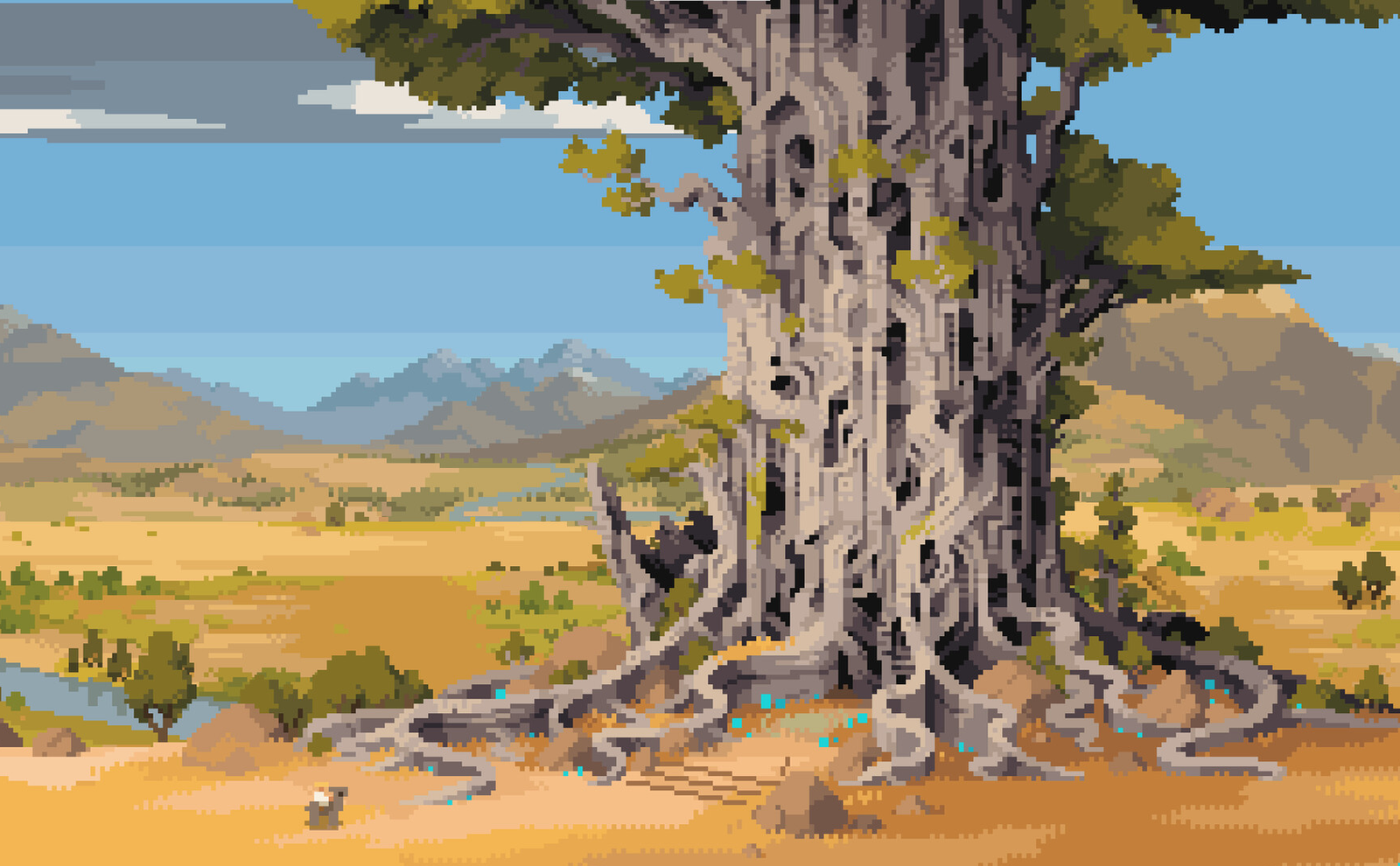
Another example is Arco, a game that routinely finds its way onto “hidden indie gem” lists. It has a winning combination of gorgeous, lo-res pixels and a genuinely standout combat system that merges real-time-with-pause tactics (horrible, horrible phrase) with elements of bullet hell and RPG combat. That isn’t the point of me bringing it up, this is not a game review per se, but I need to drive something home first: this is a good ass game.
It is also a self-described Mesoamerican narrative, with all the discomfort and honest confrontation that entails. Shooting, punching, and dodge-rolling your way through a southwest being actively colonized, it’s a classic revenge story wherein all the characters have stake in the land itself and are very much not your standard Western protagonists.
Arco should be as “American” as any other game but ends up apart from them for one simple reason: it does not support a popular, expansionist mythos of America. That might be more what I’m trying to get at here. What isn’t deemed American is almost as important as what is.
For example, rap and hip-hop, which have been some of the country’s largest cultural exports over the past few decades. Don’t get me wrong, country music hasn’t exactly slowed down in the interim, but to compare its impacts to the outsize ones had by the many offshoots of Black American music is to argue in bad faith. That influence touches everything from K-pop to the experimental depths of so-called “internet genres,” and has been at the heart of many of video games’ most memorable soundtracks.
The influences of Black fashion and music are highly visible in modern indie games as well. Aerial Knight’s games (most recently the excellent Dropshot) have continued to build on each other, and are heavily influenced by Detroit, one of the only majority-Black metropolitan areas in the country, with a rich history that sits at the forefront of Black American culture. Shawn Alexander’s recently released Beatdown City Survivors also features an OST loaded with underground rap bangers, and Okumura, a group of Black musicians and producers, churns out everything from remixes to soundtracks.
Maybe most noticeable, though, is South of Midnight, a love letter to Southern Gothic. It’s a beautiful game, exemplary of what’s possible when ambitious projects are given the support to pursue their vision. Its accolades and acceptance do point to another problem, though. There is a certain type of setting that is acceptably American, and urban areas do not fit the criteria. Despite both the legacy and cultural weight of America’s cities, theirs is an unwanted view of America outside of projects like Grand Theft Auto.
I thought about yelling about the 50 Cent PlayStation games here but realized that would be another article of at least the same size. If you forgot those games existed, here’s your reminder.
There’s something else at the heart of all this, relevant to both the America of pop culture and the real America: the gun. It’s a cultural stereotype, a narrative trope, hero and villain. Hand, machine, or smoking, it looms large in the consciousness of our country and its global image. It is valorized and villainized in equal measure, a symbol of the Old West, the military, and of invented enemies at home and abroad. It wouldn’t be a stretch to argue that the first-person shooter is the “most American” video game genre. The developers of Doom, the most quintessential FPS, are from Texas; the joke writes itself.
Call of Duty remains one of the few real juggernauts of the games industry, funded directly by the U.S. military and used as a recruitment tool. The tunnel vision of the series shows none of the openness to setting and perspective changes of other series in the genre. At the time of writing, five out of the top 10 bestselling FPS games on Steam are military themed. It’s a genre that routinely fails to ask itself simple questions intrinsic to their meaning and design: who holds the gun, and who is it pointed at?
In our current pop culture landscape of watered-down common denominators, recycled reboots, and yearning for the ease of cultural uniformity, it’s a disservice to ourselves as people and creators to uncritically buy into a single definition of “American.” For those willing to engage with it, our country is one defined and populated by a vivid tapestry of culture and art. At home and abroad, the images chosen to define us cover only the narrowest of groups and experiences. By breaking those images apart and plumbing the rich depths of our nation’s marrow, maybe we can build something better, more lived in, more interesting. We live in a very incurious time. I’d ask you to go out and be curious and then channel that in your games. No judgment if it ends up involving a bazooka.