An abandoned house in Santa Fe
Meow Wolf, Tavers, and immersive game design
by Jonah White
Inside a warehouse in Santa Fe, there is a home that once upon a time belonged to a family of seven in California. The house has been frozen in space and time, transported to New Mexico, and placed under quarantine by an organization known as The Charter.
You can explore the house and its strange secrets whenever you want. The fireplace inside leads to a cavern of icy mammoth bones and glowing worms. Tumbling through the washing machine brings you to the dimension of lost socks. We’re not allowed to talk about the refrigerator while The Charter is listening.
This is the House of Eternal Return, the first of five permanent locations created by the artist collective Meow Wolf. Started in 2008 in Santa Fe, Meow Wolf began gaining national attention in 2016 with the opening of the House.
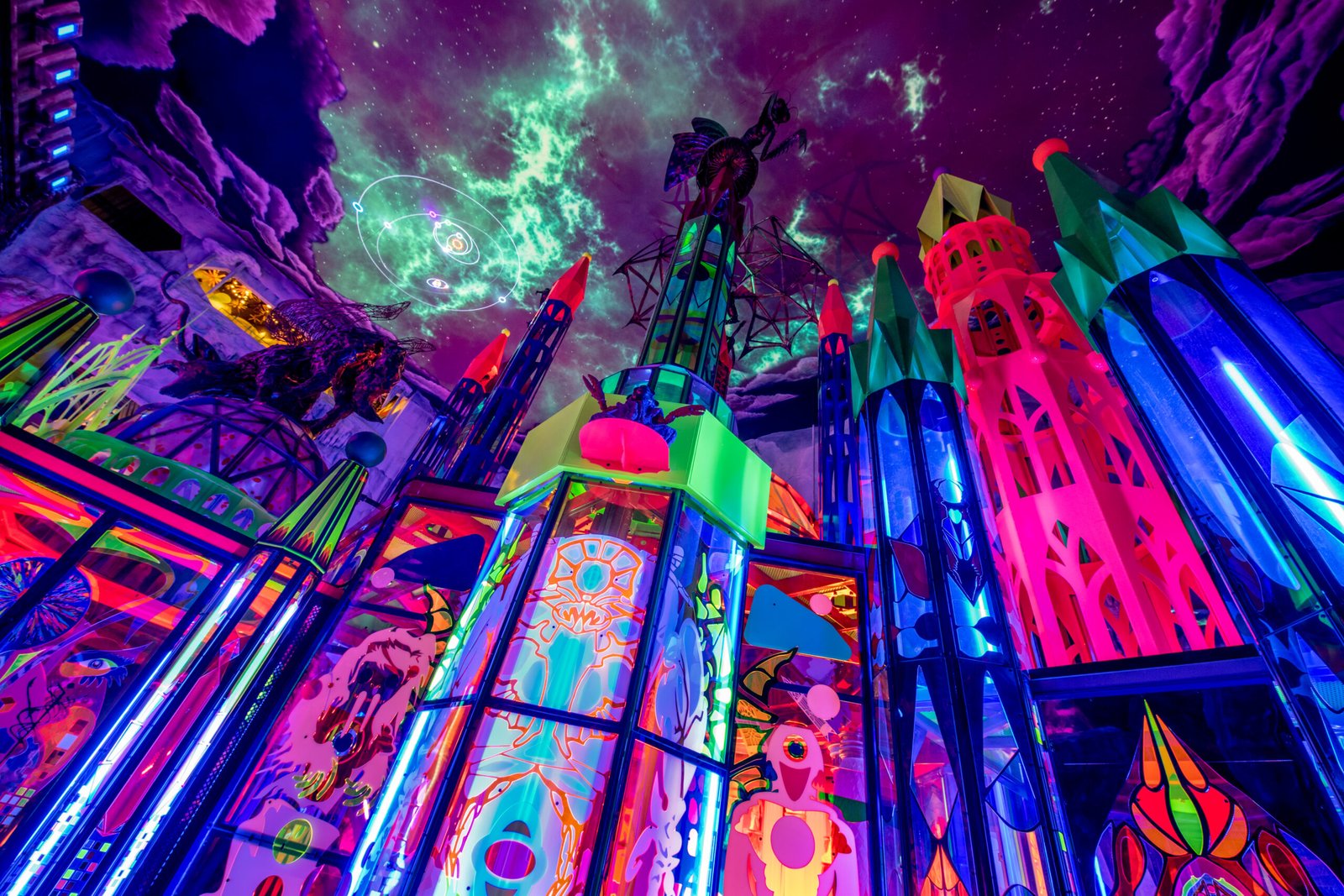
Every Meow Wolf location is unique, with new spaces to explore and stories to uncover. They have locations in Santa Fe, Denver, Las Vegas, Grapevine, and Houston with two more locations under development in Los Angeles and New York. Each installation is a collaboration between hundreds of artists of every discipline whose works are thematically tied to a narrative. Every detail inside a Meow Wolf location tells you the story of that place.
You do not have to engage with the narrative to have a fulfilling experience, either. You are free to explore each space in your own time in your own way, taking in the amazing sights and discovering new things around every corner. This makes the experience approachable to both casual and more die-hard audiences.
Meow Wolf experiences are difficult to describe because they do so many things at once. They are part art installation, part escape room, and part immersive theater. Out of all the elements that go into a Meow Wolf location, the thing that interests me most is how they incorporate game design into their experiences.
Environmental storytelling in The House of Eternal Return
Zork, the seminal text adventure from 1977, begins with the lines: “You are standing in an open field west of a white house, with a boarded front door. There is a small mailbox here.” Opening the mailbox reveals a leaflet welcoming you to the world of Zork and marks the beginning of your journey through the great underground empire.
That is what I thought of as I approached the western-facing House of Eternal Return. The house may have been olive green and the door was wide-open, but there was a small mailbox I was told should be my first stop if I was interested in the house’s story.
Inside the mailbox is a stack of letters, most of them sympathy cards from friends and neighbors consoling a family for the loss of a child. A photo is mixed in with the letters, depicting the five adults and two children that make up the Sellig-Pastore family. The last letter is addressed to an Agent 706 from “The Charter,” ordering him to investigate the house, find the missing family, and determine if the house poses a threat to the universe.
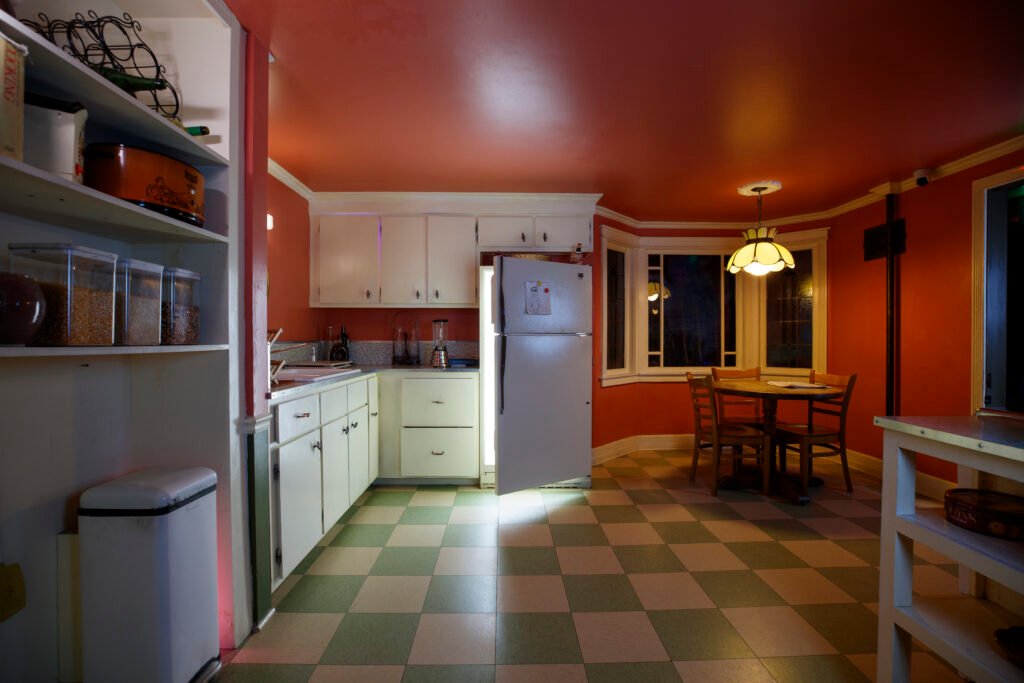
Entering the house feels like intruding on someone’s home. Children’s coats and hats hang from hooks in the entryway, family photos line the stairway, suitcases and leaflets left by the uncle who was living on the couch clutter the living room. Guests are allowed to look at and touch everything in the house, gaining an intimate look at this family’s life before their disappearance.
Exploring the house recalled memories of the 2013 game Gone Home. Just as protagonist Katie Greenbriar scoured her childhood home, sifting through magazines, leaflets, diaries, and handwritten notes looking for clues about her absent family, so too does the empty house encourage you to scour every corner to uncover the mystery of an absent family.
Just as Katie’s search digs up hidden rooms and family secrets, searching the Sellig-Pastore house turns up safe codes, hidden doors, coded messages, and secret passageways that turn the cozy family home into a labyrinth of interpersonal conflicts and dark secrets.
There is even more to discover beyond the house, within the vibrant forests, grungy alleyways, neon townscapes, and glittering caverns that make up the interconnected worlds that have anchored themselves to the house. Video terminals scattered across these other worlds reveal the origins of the universe and The Charter through animated cutscenes, and audio messages fill the empty spaces like the doomed audio diaries of Bioshock’s Rapture.
Walking through a Meow Wolf exhibit is like walking through a real-life adventure game. You piece together the story from fragments gathered at your own pace in any order you choose. The experience encourages and rewards paying close attention in a way that I have rarely seen outside of a video game.
Worldbuilding through games at Convergence Station
Within the House of Eternal Return there is an arcade parlor called Wiggy’s Plasma Plex. Inside are hand-painted cabinets featuring classic games such as Joust and Galaga, modern classics like Cuphead, and a television playing an interview with one of the missing family members. Meow Wolf doesn’t just borrow the structure of narrative video games; video games are an integral part of the artistic vision of the experience.
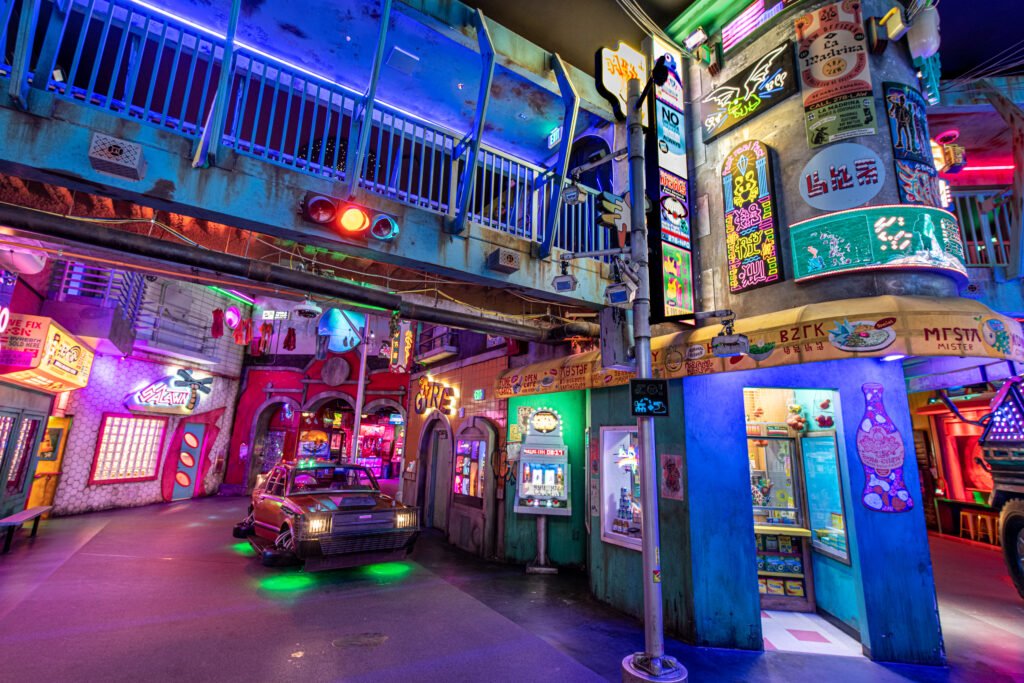
Convergence Station, Meow Wolf’s third location, takes this concept of video games as world building a step further. Nearly three times the size of the House of Eternal Return, Convergence Station depicts four alien worlds that have collided to become one single world, connected to our world by the Quantum Department of Transportation, or QDOT. The first world you visit, the cyberpunk cityscape known as C-Street, features multiple bespoke video games created for the experience.
A ‘90s boom box sits on a messy street cart with a screen in place of a tape deck. Using the tuning dials, you and a friend can play a version of Pong on the boom box. There is a hidden pachinko parlor/currency exchange that dispenses collectible memories called MEMs, which also serve as currency in the world of Convergence. There are competitive voting booths that have you cast a vote for a new mayor every twenty minutes by playing a game of reflexes. A dead-end back alley features a competitive motion-controlled game, and you can hack the power grid by playing a secret mini game that briefly takes over all the TV screens in C-Street.
Beneath C-Street in the catacombs of the world Ossuary, there is even more to discover, including the rock-em-sock-em game Rat Battler II and an underground Chuck E. Cheese-like pizzeria featuring the 3D platforming arcade game Rat King.
One of my favorite moments in Convergence Station was picking up one of the many pay phones and dialing a random number from the directory. A prerecorded woman’s voice began to narrate her investigation into the disappearance of a major character. Eventually, she had to make a decision and asked me to punch in one of two numbers to pick her next move. Before I knew it, I was playing a full-on choose-your-own-adventure game on the telephone. The experience reminded me of “Here and There Along the Echo,” the interlude from Kentucky Route Zero, which featured a similar phone-based dialogue tree.
Every one of these interactive games adds flavor and context to the world of Convergence Station. However, for those wanting the full story, you need the QPASS. The QPASS is a $3 “transit card” that uses RFID tracking to record your progress while exploring the exhibit. RFID is a common tool in interactive experiences such as escape rooms and was famously a major feature of the Star Wars Galactic Starcruiser experience at Disney World.
Periodically throughout the exhibit, there are stations where you can scan your QPASS to unlock memories that reveal parts of the overarching plot. Finding all of these terminals leads to you working with an NPC and culminates in a climactic showdown with the villain of Convergence Station. The story even features two possible endings depending on your choices at the end.
Tavers: The Meow Wolf RPG brings art to the tabletop
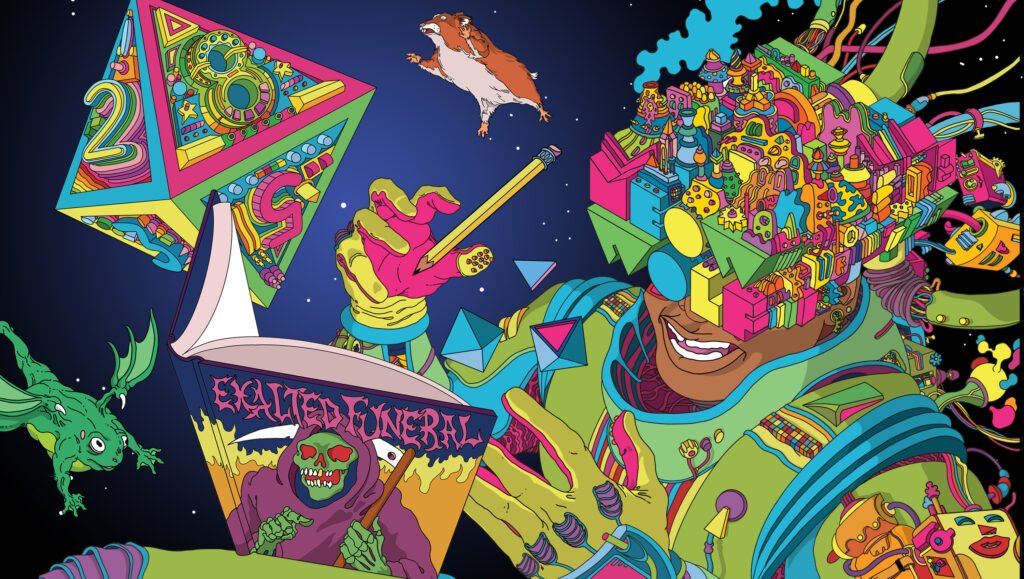
If Meow Wolf can borrow from games to build their worlds, what can games borrow from Meow Wolf? Exalted Funeral, publisher of tabletop role-playing games such as Dolmenwood, Old School Essentials, and Monty Python’s Cocurricular Mediaeval Reenactment Programme, seeks to answer that question.
Tavers: The Official Meow Wolf RPG was announced in August 2025, successfully crowdfunded on April 7, 2026, and is slated for release later this year.
The game is not just a guide to Meow Wolf’s complex multiverse; it is a tool kit that allows players to create their own worlds and stories that embody the Meow Wolf ethos. It’s a game of collaborative storytelling and boundless imagination that celebrates the power of creativity to change the world.
The rules shared so far are simple. Unlike many TTRPGs, there are few dice rolls and almost no numbered stats to keep track of. Instead, the game relies on generating keywords that players can use to create more opportunities for storytelling. For example, players might narrate the story of how their characters first met. The story involves the characters crashing into each other at a party and laughing about the incident over drinks. This could generate the keywords “crash,” “party,” and “laugh.” These simple words can then be invoked to give characters advantages in situations involving laughter, parties, or crashing into things.
Resources come in the form of “source points” that act as both health and action points, limited resources called “source tokens” that can be used to do extraordinary things, “mems” which are the aforementioned keywords and your primary means of action, and “itemtronicals,” which are items that fit onto your character sheet like Tetris pieces and resemble the inventory system from Resident Evil 4.
The game is incredibly free-form and uses the tools of game design to encourage players to build their own worlds and tell their own stories. While we have yet to see what the final product looks like, the evidence so far shows that Tavers will continue the Meow Wolf tradition of using game design as a tool for creativity and world-building.
Is art video games?
For years, people have asked the question, “Can games be art?” Meow Wolf turns the question around and asks, “Can art be a game?”
Meow Wolf uses every creative tool at its disposal to craft breathtaking worlds of staggering complexity and beauty. Through lighting design, set design, sculpture, painting, collage, and prop-making, Meow Wolf transforms the mundane into the sublime. It is heartwarming to see game design become another tool in this amazing creative toolbox.
If you haven’t visited a Meow Wolf location, I encourage you to do so. You never know where you’ll find inspiration for your next creative project.