Working together to combat loneliness
The impacts of coworking and community spaces among Chicago game developers
by D. Myerscough
The world of video games is one of extremes. The public may hear glamorous stories of indie studios making it big with nothing but heart and hard work or depressing ones full of layoffs and crunch.
The truth, for most developers, is somewhere in the middle. Like Charles Voita, an industry veteran who has spent 13 years as a programmer. Voita worked in a traditional studio in Los Angeles before the pandemic, which transitioned his workload almost entirely to remote-based work.
“I started getting remote work when I was in Los Angeles,” Voita said. “I worked on a game, we released it, and then I started to get other jobs that happened to be remote.”
It wouldn’t be long before remote work became a necessity for him, though. Voita’s wife is a professor, and the pair would move to Chicago in 2022 so that she could pursue a job. The pair landed first in Evanston, a northern suburb of the city, then later in Edgewater, on the city’s north side.
Voita spoke quickly, full of jittery energy that’s hard to explain. He admitted to struggling with social anxiety from behind thick glasses and a half smile.
When asked for his opinions on broad topics, he stammered, unsure. But when the conversation switched to Chicago, his tone changed entirely, landing on one of pure adoration.
“I love Chicago, I’m the biggest Chicago fanboy,” he said. “I lived in LA for like a decade, but it’s so special here.”
What is it that he loves the most? The public transit, for one. But also, the community of game developers he’s found over his four years in the city.
“The community is really special. It doesn’t have any sense of elitism or anything,” he said.
Voita wouldn’t find that community immediately, though. Like many who move across the country, he experienced a lot of loneliness in his first year in Chicago.
“When I moved, I didn’t know anyone,” he said. “When you’re not in the office and you’re working entirely remote, the discipline becomes very isolating.”
This isolation is not uncommon, and it’s something experts are increasingly concerned about as well. According to a recent study by the Pew Research Center, one in six Americans feel lonely or isolated “all or most of the time,” with another 38% saying they “sometimes feel lonely.”
Additionally, a 2023 report from the Surgeon General of the United States said, “the mortality impact of being socially disconnected is similar to that caused by smoking up to 15 cigarettes a day.”
With stakes like that, it has become increasingly important to find ways to combat chronic loneliness, especially in those without robust support systems. One solution may be seeking out in-person groups or events that align with a person’s interests, which is exactly what Voita did after his move.
“I was kind of lonely, so I was looking for people who play [Super Smash Bros.] Melee in the area,” he said. “I used to play Melee when I was younger and that’s one way I would make friends when I moved to a new area.”
He connected with a group on Discord, a messaging app, who were mostly inactive. But it was through that group that he would meet Kyle Lueptow, another game developer who shared Voita’s passion for the game.
That wasn’t all they shared.
“After I met Kyle, I opened my mailbox and I was like, wait a minute, that can’t be,” he said. “It was mail for Kyle. He lived in my exact apartment before I did.”
The two met up and played Super Smash Bros. and Lueptow introduced Voita to the Indie City Games Discord channel, an online community of Chicago-based independent video game developers. He fit right in.
The group is full of artists and developers who meet up often for coworking sessions at coffee shops and showcase their work at gallery shows about once a quarter. It was at one of these shows that Voita would be introduced to the wider community through one of its major organizers, David Antognoli.
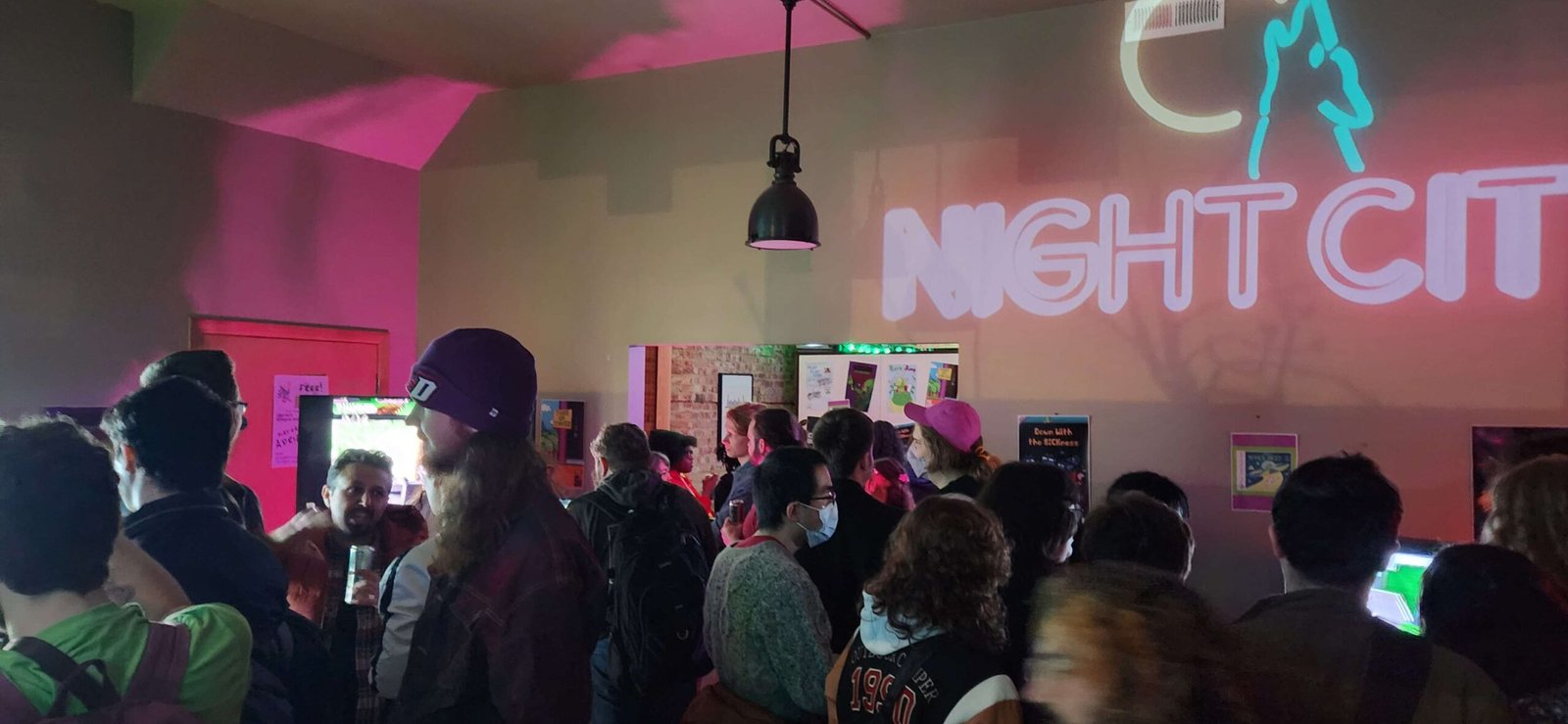
“I still remember my first event, it was Chicaghoul 2023 at Night City,” Voita said. “I remember the only person I spoke to was David, and I didn’t know he was the owner of Night City.”
Night City, much like its owner, contains multitudes. The space is a tiny gallery dedicated to the somewhat odd goal of championing community-centered video game development.
The current landscape of independent game development is one of isolation, according to Antognoli, who is, in addition to his work as an organizer, a tenure-track professor of game design at Columbia College Chicago.
“You put your thing out on the internet and it’s like, maybe people interact with it, maybe they don’t,” he said. “I found that personally very isolating, but I’ve found a lot more satisfaction presenting work in person.”
That feeling of satisfaction extended across the community and has spurred others to get more involved, killing their loneliness by making games together.
Jonah Lillioja, the outreach director for Indie City Games, has a similar story to Voita. He felt lonely working from home and was in search of spaces that would connect him with peers in the video gaming space.
“A medium like video games, both as a player and a creator, can be quite isolating,” Lillioja said. “I joined the community and helped grow Indie City Games because I thought Chicago needed a space that could fight that isolation, especially in person.”
It was Indie City Games and Night City that put on Chicaghoul together in 2023. The event was a horror-themed showcase that highlighted the work of several local developers working alone and in teams. Through that event, developers were able to inspire each other and share feedback by playing each other’s games.
Voita remembers that event as the beginning of his love affair with the Chicago game development community, and he recounts how seeing the work of others made him want to go to more events and make projects of his own to show off.
“Imagine the world is all clouds and all of a sudden, there’s a beam of light from the sky,” he said. “That’s how the events felt to me. I was unemployed at the time, but I could go to these events, I could meet with people and I could work on cool stuff. That was so important.”
According to clinical therapist Katelynd Burd, socialization in general, but especially with peer groups, can play a huge role in alleviating symptoms of depression and isolation.
“Humans are designed to be social creatures, so community spaces are important for all of us,” Burd said. “Conversing with others is a need comparable to eating food or drinking water.”
For those developers stuck in an isolating cycle of development, marketing and what Antognoli calls “a void of feedback,” events like Night City and ICG’s showcases can be important, but what really sets the community apart is its dedication to in-person coworking.
Coworking is a practice where groups of people work on their own projects in the same physical space, and it has functioned in the Chicago independent game development community as a way to keep lonely developers connected.
Dani Orizaba, a game developer and member of the Chicago community, cites coworking as the thing that integrated her into the community after several years of developing completely alone.
“That regular, weekly meeting, where I was seeing a lot of the same people and working on stuff with them, that’s what got my roots in the community,” Orizaba said.
Consistency is another important part of combating loneliness. Burd said that in a world that has become less comfortable with social interaction, finding ways to connect with other people is key.
“I believe avoiding others has been built into the current culture a bit,” Burd said. “You don’t have to talk to a cashier at most stores, for example.”
Obstacles like that, in their opinion, naturally cause loneliness. However, widening and strengthening support networks by keeping up with regular socialization makes it easier to bounce back from bouts of loneliness and depression.
In-person social events like coworking and showcases are the cornerstones of the Chicago community, but the gaps between them are filled by several Discord communities meant to keep up consistent communication between community members.
Voita calls these Discord servers “the glue” between events, and Lillioja stresses that the Indie City Games Discord is meant to support the physical aspects of the community, not replace them.
“As people join the Discord, they’re immediately reminded that this is a physical community,” Lillioja said. “We want you to use your real name because you’re going to be seeing these people in person.”
However, for some community members, they only care to participate in an online capacity, whether because of social anxiety or because they are too busy. Community newcomer Makayla Lynne has never been to an in-person event and isn’t sure if they’ll fit into her own practice.
In the efforts to combat online loneliness, there may be a happy medium between in-person events, what Antognoli calls “analog participation” and the kinds of online communities that cater to the socially anxious.
As far as Voita is concerned, though, the Chicago independent gaming community is not one he’d like to see change too much.
“The community is so special, it’s very inclusive and everyone is just there to make cool stuff and lift each other up,” Voita said. “Wherever it goes, so long as it keeps its authentic self, I’ll be happy.”